The Agentic Revenue Brief
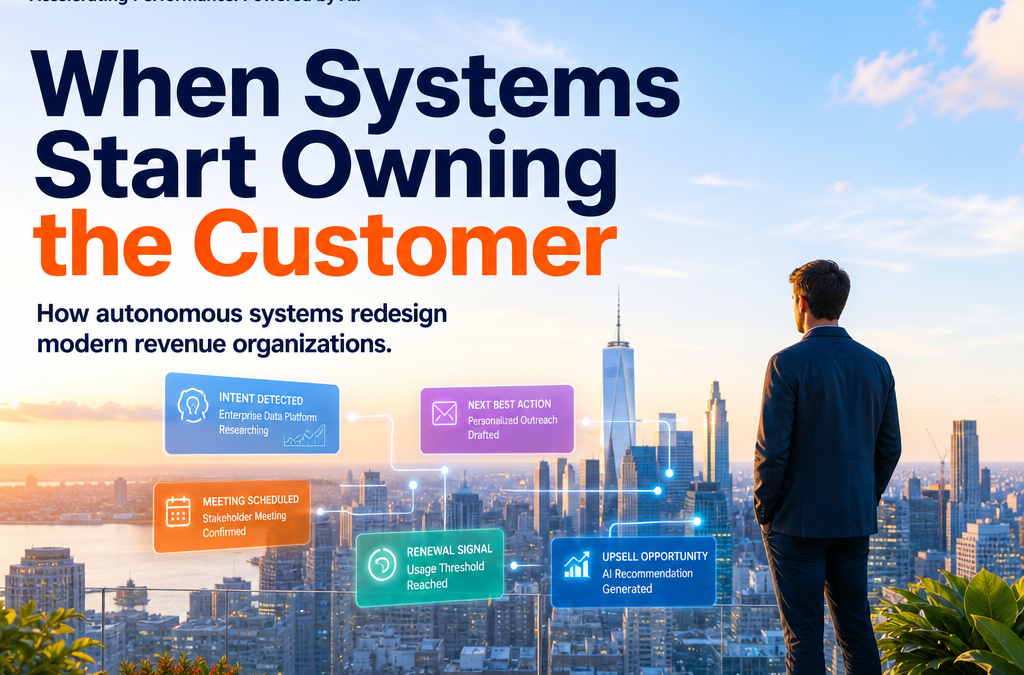
How autonomous systems redesign modern revenue organizations.
Edition Title:
When Systems Start Owning the Customer
If you have just 1 minute
This week’s structural shift is that “customer operations” is quietly becoming an autonomous system, not a function. The center of gravity is moving from human-led workflows (SDR sequences, AE follow-up, RevOps routing, CS playbooks) to agent-led execution loops that watch signals, decide next-best actions, and trigger work across systems without waiting for a rep to notice the moment.
That matters now because the winners aren’t adopting more AI—they’re redesigning how accountability, data rights, and decision authority work when non-human actors can initiate revenue-impacting actions. Leaders who still treat autonomy as “automation inside existing roles” will get cost without compounding advantage. Leaders who treat autonomy as a new operating layer will compress cycle times, widen coverage, and raise forecast integrity—while competitors argue about prompt quality.
If you run Sales, RevOps, Marketing Ops, or own the forecast, pay attention. The question is no longer “which tool?” It’s “which decisions do we allow the system to make—and how do we govern that at scale?”
This week’s developments you should not miss
Salesforce Summer ’26: Agentforce Sales moves into the seller’s operating layer (Slack)
What happened
Salesforce pushed Agentforce Sales deeper into daily execution by embedding agentic work inside Slack—where sellers coordinate, escalate, and decide in real time.
Why it matters structurally
This is the redefinition of CRM from “system of record” to “system of action.” When agents live inside the collaboration fabric, they don’t just update fields—they participate in the cadence of decisions. The CRM becomes less a database and more an orchestration engine that can initiate outreach, propose next steps, and manage handoffs without rep-driven prompts.
How this shifts revenue workflows
Pipeline creation becomes continuous monitoring + intervention, not periodic human effort. Expect fewer calendar-bound rituals (batch prospecting, weekly hygiene) and more event-driven selling (agent detects intent, drafts outreach, requests approval, executes). The workflow shifts from “rep does tasks” to “rep approves/edits decisions.”
Who gains leverage
Teams with strong operating definitions—stage criteria, exit signals, routing rules, and consistent activity standards—because agents can execute reliably when the system is well-specified. RevOps leaders who own decision logic gain disproportionate influence.
Who becomes exposed
Orgs with “tribal process.” If your pipeline depends on individual rep judgment to interpret signals, agents will either underperform or create risk. Also exposed: sales leaders who equate activity volume with productivity—agents will flood activity unless governed by outcome constraints.
Virtusa research: the agentic divide links customer-data strategy directly to revenue growth
What happened
A large-enterprise study drew a line between “customer-obsessed” firms (customer data treated as a strategic asset) and “customer-indifferent” firms—showing materially different growth outcomes and readiness to deploy agentic AI.
Why it matters structurally
The key implication isn’t “data is important.” It’s that autonomy is a data-rights problem. Agents need permissioned access to customer truth (identity, intent, entitlements, product usage, commercial terms) and a consistent definition of what “customer-centric” means in executable logic. Without that, autonomy collapses back into brittle automation.
How this shifts revenue workflows
Customer operations becomes a closed-loop system: detect → decide → execute → measure → learn. The “detect” layer is no longer only Marketing (lead scoring) or CS (health scoring). It becomes unified signal intake where product usage, billing events, support friction, and buying committee motion all trigger revenue actions. That compresses upsell timing, reduces leakage, and changes how territories and coverage are designed.
Who gains leverage
Companies that treat customer data as a governed product—clear ownership, definitions, and service levels. Leaders who can unify Sales + CS + Product signals into a single action model will take share because they’ll respond faster and with more relevance.
Who becomes exposed
Organizations that built RevOps around reporting rather than control systems. Dashboards don’t run an autonomous revenue loop. Decision frameworks do. Also exposed: any team relying on disconnected “AI pilots” that never touch core customer data due to security or political friction.
SAP Sapphire: “Autonomous Enterprise” positioning turns ERP into a multi-agent execution fabric
What happened
SAP advanced its Business AI Platform and “Autonomous Suite” narrative—deploying domain-specific assistants across functions including customer experience.
Why it matters structurally
Revenue isn’t owned by the CRM alone anymore. When the ERP layer becomes agent-ready, agents can execute commercial decisions with financial consequences: pricing constraints, invoice terms, entitlement checks, renewals, provisioning, and credit logic. This collapses what used to be cross-functional latency—Sales waiting on Finance, CS waiting on Ops—into coordinated machine-to-machine workflows.
How this shifts revenue workflows
Expect “deal desks” to change form. The old model: humans interpret policy and approve exceptions. The new model: agents pre-adjudicate within policy bounds, route only true exceptions, and maintain a full decision trace. Renewal and expansion motions become less calendar-based and more contract/consumption-triggered.
Who gains leverage
Enterprises that can encode commercial policy (discounting, bundling, approvals, risk) into machine-executable guardrails. Finance and RevOps leaders who collaborate on policy-as-code become strategic growth enablers, not gatekeepers.
Who becomes exposed
Companies whose commercial policy lives in email threads and “what we did last time.” Autonomy will force explicitness. If you can’t articulate your rules, you can’t safely delegate to agents—and your cycle times will lag behind those who can.
OpenAI’s ChatGPT Ads Manager: conversion economics shift toward AI-mediated discovery
What happened
OpenAI expanded self-serve advertising inside ChatGPT, with ecosystem integrations and early performance indicators suggesting stronger conversion behavior than traditional channels in some categories.
Why it matters structurally
This is a revenue model shift: the “top of funnel” is migrating from search-driven intent capture to agent-mediated intent formation. If the buyer’s first interaction is an AI system that recommends, compares, and filters, then your marketing architecture must optimize for machine interpretability (structured product facts, proof, differentiation) rather than just human persuasion.
How this shifts revenue workflows
Demand gen becomes “AI shelf space” management. Sales enablement shifts toward packaging claims into verifiable artifacts agents can cite. Attribution gets harder and more important: when an AI agent influences the buying path, your measurement must track machine referrals, not just clicks and form fills.
Who gains leverage
Companies with clean catalogs, strong proof assets, and fast feedback loops between marketing, product, and sales. If your value story is precise and verifiable, AI-mediated channels will amplify it.
Who becomes exposed
Brands relying on vague positioning or heavy retargeting mechanics. AI discovery rewards clarity and utility. It punishes ambiguity because the agent needs hard edges to recommend you confidently.
Anthropic’s “Claude for Small Business”: agentic workflows productized for non-enterprise GTM stacks
What happened
Anthropic packaged connectors and ready-to-run workflows aimed at SMB operators across sales, marketing, finance, and operations.
Why it matters structurally
This signals commoditization of “agentic execution” as a bundle—reducing the moat of enterprises that believed autonomy would be gated by integration complexity. As SMBs gain packaged autonomy, competitive pressure rises in long-tail markets: response times, personalization, and operational consistency improve without headcount growth.
How this shifts revenue workflows
For SMBs, the “RevOps function” may emerge as software, not a hire. For enterprises, it’s a warning: your smaller competitors can now operate with enterprise-grade execution discipline. That increases churn risk and raises the bar on customer experience consistency.
Who gains leverage
Operators who can standardize process quickly. SMBs that adopt agentic workflows early will out-respond and out-follow-up bigger competitors with slower internal coordination.
Who becomes exposed
Mid-market companies stuck in the middle: too complex to run on “out-of-the-box autonomy,” too under-invested to build robust governance and orchestration. They will face pressure from below (cheap autonomy) and above (deep autonomy).
What This Means for Revenue Design
Org charts will shift from role lanes to decision ownership. SDR/AE/CS boundaries were built around task execution. Agents take tasks. Humans must own decisions: qualification thresholds, escalation rules, pricing authority, renewal timing, risk tolerance. The redesigned org chart is a map of who sets constraints—and who audits outcomes.
SDR and AE work becomes exception-driven. If agents can prospect, draft outreach, and schedule, SDR capacity becomes less about volume and more about edge cases (new ICPs, complex accounts, regulated messaging). AEs spend more time on multi-thread strategy, procurement, and consensus building—less on chasing internal follow-ups.
RevOps becomes a control-systems function. Traditional RevOps optimized reporting, routing, tooling, hygiene. Agentic RevOps must design feedback loops: what signals trigger actions, what guardrails prevent damage, what metrics detect drift, what human approvals are required at each risk tier.
Forecasting shifts from “commit culture” to “system confidence.” As agents execute more of the motion, the forecast becomes less about rep optimism and more about signal quality, policy adherence, and model calibration. Accountability moves from “did the rep do the activities?” to “did the system generate the right interventions—and did leaders set the right constraints?”
Governance must become real-time, not quarterly. Agent behavior needs continuous monitoring, permissioning, and audit trails. Approval chains should be risk-based: low-risk actions auto-execute; medium-risk actions require fast human confirmation; high-risk actions require documented policy exceptions.
Human judgment becomes more critical at the edges. Autonomy handles the median case. Leaders must invest in judgment where it matters: brand risk, strategic accounts, pricing integrity, and ethical boundaries. The skill is not “using AI.” It is designing a system where AI can act without eroding trust, margin, or compliance.
Watch For This Inside Your Organization
- Your “AI wins” are activity metrics. More emails, more sequences, more notes—without measurable cycle-time compression, win-rate lift, or churn reduction.
- Agents can’t access core customer truth. Security, silos, and politics prevent agents from seeing entitlements, usage, support history, or contract terms—so autonomy stays superficial.
- RevOps is asked to “deploy tools,” not redesign decisions. If no one owns guardrails, approval logic, and auditability, you’re scaling risk, not performance.
- Exception volume increases after automation. If humans spend more time cleaning up weird edge cases, your process is underspecified and your constraints are wrong.
- Forecast debates center on narratives, not signals. If you can’t explain what the system saw, what it did, and why, your autonomy layer is not governable—and won’t be trusted.
If I Were a CRO This Week
I would run a 30-day “Agent-Owned Renewal Loop” with hard governance.
Pick one segment (e.g., mid-market renewals), and delegate a bounded set of actions to an agent: monitoring usage + support signals, drafting renewal outreach, scheduling touches, and generating a renewal risk score. Impose constraints: no pricing changes without human approval; every action must log a reason code; every account gets a weekly decision trace summary. Measure outcomes against a control group: cycle time, save rate, expansion attach, and forecast variance.
The goal isn’t to “prove AI.” It’s to establish whether your organization can operate a governed autonomous loop without breaking trust, margin, or accountability.
Closing Insight
Autonomy is forcing revenue leaders to confront an uncomfortable reality: your GTM system was designed for humans with limited attention, not machines with continuous perception. When agents can act, the constraint becomes organizational clarity—policy, definitions, permissions, and accountability. The durable advantage won’t come from having agents; it will come from having a revenue architecture that lets agents operate safely, measurably, and faster than your competitors can coordinate. In that world, leadership is less about motivation and more about system design.
All the best -Tim Cortinovis