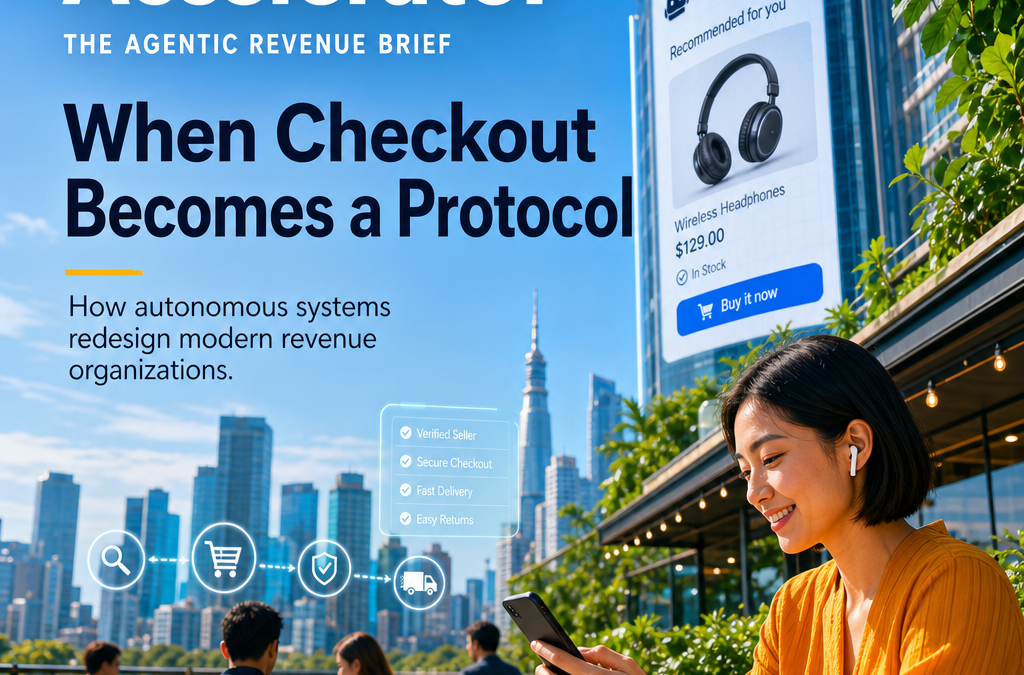
The Agentic Revenue Brief
How autonomous systems redesign modern revenue organizations.
Edition Title:
When Checkout Becomes a Protocol
If you have just 1 minute
The structural change this week is not “better AI.” It’s the beginning of a new revenue surface area: agents becoming the transactional interface, not just an enablement layer.
When buyers can delegate discovery, evaluation, and purchasing to autonomous systems, your revenue org stops “running tools” and starts operating a machine-readable go-to-market: product data, pricing rules, eligibility, compliance, identity, and fulfillment become APIs and policies agents can execute against.
This matters now because the center of gravity shifts from persuasion and outreach volume to being the default option inside agent workflows. Leaders who should pay attention: CROs owning multi-channel growth, RevOps leaders accountable for forecast integrity, and CMOs who increasingly control the “inventory” agents will shop—structured information, proof, and attributable outcomes.
This week’s developments you should not miss
OpenAI: “Buy it in ChatGPT: Instant Checkout and the Agentic Commerce”
What happened
OpenAI positions ChatGPT not only as a discovery interface, but as a checkout-capable execution layer—collapsing the distance between intent (“I want X”) and transaction (“I bought X”).
Why it matters structurally
Revenue no longer depends exclusively on owned web journeys or human-led deals. The strategic asset becomes transaction readiness for agents: validated product facts, inventory/availability, pricing constraints, returns, identity, and fraud controls—encoded so an agent can complete a purchase without ambiguity.
How this shifts revenue workflows
RevOps and Product Ops inherit responsibilities traditionally split across Marketing (content), Sales (qualification), and Commerce (checkout). Expect new workflows around:
- Agent-readable product catalogs (not just pages)
- Policy-driven offer construction (what an agent is allowed to discount/choose)
- Exception handling (handoff to humans when confidence drops)
The “sales funnel” becomes a policy funnel: what the system can approve, verify, and execute.
Who gains leverage
Companies with strong operational data foundations (clean SKU/packaging, clear terms, fast fulfillment) and those who can define guardrails as code. Also: teams with disciplined attribution models—because agent-driven transactions will challenge standard channel reporting.
Who becomes exposed
Organizations dependent on opaque pricing, human-only approvals, and fragile checkout/contracting paths. If the path to buy requires a chain of emails, your conversion rate will be taxed by agent impatience.
Google: “New tech and tools for retailers to succeed in an agentic shopping era”
What happened
Google frames “agentic shopping” as an ecosystem shift and signals an emerging standard/protocol layer for commerce discovery and execution.
Why it matters structurally
Protocols create power laws. If agentic commerce runs through standardized feeds, permissions, and transaction primitives, then advantage accrues to whoever controls:
- the protocol (rules of participation),
- the ranking (which options agents surface), and
- the measurement layer (what “performance” means).
This is not a channel expansion; it is a redefinition of distribution.
How this shifts revenue workflows
Marketing and RevOps must treat structured data as a revenue system, not hygiene. You’ll need operating cadences for:
- feed governance (accuracy, freshness, eligibility)
- offer policy management across agent contexts
- closed-loop learning from agent-driven outcomes (what gets selected, not what gets clicked)
The “creative” becomes less about messaging and more about machine-interpretable proof: warranties, delivery SLAs, verified reviews, and compliance signals.
Who gains leverage
Brands with superior operational signals (delivery reliability, returns performance, service responsiveness) because agents will optimize for risk-adjusted satisfaction, not just price.
Who becomes exposed
Teams with disconnected commerce, marketing, and finance systems. If margin rules, inventory truths, and promotional constraints aren’t unified, agents will produce inconsistent experiences—or route demand to competitors with cleaner execution.
Goldman Sachs: “AI Agents Forecast to Boost Tech Cash Flow as Usage Soars”
What happened
Goldman frames agent adoption as a usage-driven economic expansion—implying a meaningful increase in compute/token consumption and downstream cash flow for the ecosystem enabling agents.
Why it matters structurally
Revenue leaders should read this as a warning: unit economics will move into your org chart. As autonomous workflows scale, “AI cost” stops being experimentation overhead and becomes a managed cost-of-revenue line with optimization pressure comparable to cloud spend.
How this shifts revenue workflows
Forecasting must incorporate:
- agent activity volumes (actions taken, not just leads created)
- cost-to-serve per autonomous workflow
- conversion confidence bands based on model reliability and data access
RevOps will need a FinOps-like discipline: budgets, guardrails, anomaly detection, and continuous optimization tied to business outcomes (pipeline created, cycle time reduced, renewal risk lowered).
Who gains leverage
Operators who can connect autonomous activity to financial outcomes—proving marginal ROI per automated action. Companies with strong data contracts between systems (CRM, billing, support, product usage) will manage agent economics better than those with fragmented stacks.
Who becomes exposed
Any team measuring “AI success” via adoption counts. When usage soars, cost and accountability will surface quickly. If no one owns the economics, your agent initiative becomes a silent margin leak.
Intel: “Solving the Agentic AI Trilemma – Cost, Scale, and Data Security”
What happened
Intel highlights the constraint triangle for agentic systems: cost, scale, and data security—arguing that making agents viable in enterprise settings requires tradeoffs and infrastructure design, not demos.
Why it matters structurally
This is the governance signal: as agents begin to execute revenue-impacting actions, the organization must treat them like operators with credentials. Security and data boundaries are no longer IT concerns; they define what revenue work can be delegated safely.
How this shifts revenue workflows
Expect a redesign of “who can do what” inside the revenue engine:
- Agents that can touch pricing require financial controls.
- Agents that can contact accounts require brand and compliance controls.
- Agents that can change CRM fields require auditability and rollback.
The workflow shift is from manual approvals to policy-based execution with audit trails.
Who gains leverage
Companies that implement least-privilege access, data segmentation, and reliable logging—enabling agents to act broadly without increasing enterprise risk proportionally.
Who becomes exposed
Teams deploying agents with shared credentials, unclear data provenance, or no action-level audit. The first agent-caused compliance issue will trigger centralization—often killing momentum and pushing autonomy back into “assist mode.”
“AI Agency Predictions 2026: Where The Real Money Is Moving” (YouTube)
What happened
Market commentary signals accelerating spend toward “AI agencies” and service layers that operationalize agents—building workflows, integrations, and performance management around autonomous systems.
Why it matters structurally
This is a capacity signal: many companies will not build agentic revenue systems purely in-house. A new externalized function is emerging—autonomy operations—analogous to the early days of RevOps consulting, but centered on agent reliability, governance, and integration.
How this shifts revenue workflows
Leaders will increasingly buy outcomes: pipeline actions executed, cycle time reduced, renewal expansion playbooks run by agents—with service firms packaging operating models and guardrails. The risk is outsourcing core learning loops: if vendors tune your agents, they own your compounding advantage.
Who gains leverage
Companies that use external help to accelerate design, but keep strategy, data contracts, and evaluation frameworks internal. Firms that treat agencies as temporary scaffolding will move faster without surrendering differentiation.
Who becomes exposed
Organizations that outsource autonomy without building internal ownership. They will struggle to govern, measure, and evolve systems—resulting in brittle automations and unclear accountability when outcomes drift.
What This Means for Revenue Design
Revenue org charts will evolve toward “policy + platform” leadership. Expect a new spine that sits between RevOps, Product, Security, and Finance: a function responsible for agent permissions, workflow design, measurement, and exception handling.
SDR/AE/RevOps boundaries will blur, then re-harden around accountability. Agents will absorb large portions of SDR work (research, routing, first-touch sequences) and parts of AE work (proposal generation, mutual action plans, stakeholder mapping). The human roles won’t disappear; they will shift to:
- deal strategy (multi-threading, political navigation)
- risk adjudication (when the agent flags uncertainty)
- value engineering (outcome framing tied to customer economics)
RevOps becomes less “CRM admin” and more systems governor.
Forecasting and accountability will move from stages to signals. Agent-driven systems create granular telemetry: actions taken, buyer responses, time-to-next-step, policy exceptions. Forecast calls will depend less on rep sentiment and more on instrumented evidence—but only if governance prevents metric gaming by autonomous activity.
Governance must adapt from approvals to bounded autonomy. The scalable model is not “human approves everything.” It is:
- clearly defined authorization tiers,
- continuous auditability,
- rollback and containment when behavior deviates.
Treat agents like junior operators with escalating permissions—not like software features.
Human judgment becomes more critical at the edges. The more the core workflow is automated, the more value concentrates in ambiguity: novel competitors, atypical procurement, unusual legal terms, and strategic account politics. Leaders must staff and train for exception mastery, not task volume.
Watch For This Inside Your Organization
- You measure “agent adoption,” not economic output. If you can’t tie autonomous actions to pipeline quality, margin, retention, or cycle time, you’re scaling cost—not leverage.
- Agents operate without explicit permission design. Shared logins, broad CRM write-access, or unclear communication policies are early indicators you’re one incident away from a shutdown.
- Automation grows, but the workflow never gets redesigned. If you’re bolting agents onto the same SDR/AE handoffs, you’ll amplify handoff friction rather than remove it.
- RevOps owns tooling, but no one owns outcomes. When autonomy spans Marketing, Sales, and CS, “platform ownership” is not “business accountability.” This gap becomes visible in forecast volatility.
- Your data model isn’t agent-ready. Inconsistent product/pricing rules, ambiguous fields, and ungoverned content libraries will produce unreliable agent behavior—and reputational risk at scale.
If I Were a CRO This Week
Run a 30-day “bounded autonomy” experiment with one measurable revenue workflow—and publish the policy.
Pick a workflow with clear economics (e.g., inbound qualification-to-meeting set, renewal risk triage, or pricing/packaging recommendation for a single segment). Define:
- the actions the agent may take,
- the data it may access,
- the confidence threshold for autonomous execution,
- the human escalation path,
- and the scorecard (pipeline created, cycle time, win rate impact, cost-to-serve).
The goal isn’t to “deploy AI.” It’s to establish a repeatable pattern for turning autonomy into governed revenue capacity.
Closing Insight
Agentic systems are not arriving as another layer in the stack; they are becoming the layer that decides and executes across the stack. That forces a shift from managing people-to-tools productivity toward managing policy-to-outcome reliability.
In the near term, competitive advantage will come from organizations that make their offers legible, executable, and trustworthy to agents—while keeping costs and risk bounded. Autonomy will reward leaders who can redesign accountability, not just accelerate activity.
All the best -Tim Cortinovis