The Agentic Revenue Brief
How autonomous systems redesign modern revenue organizations.
Edition Title:
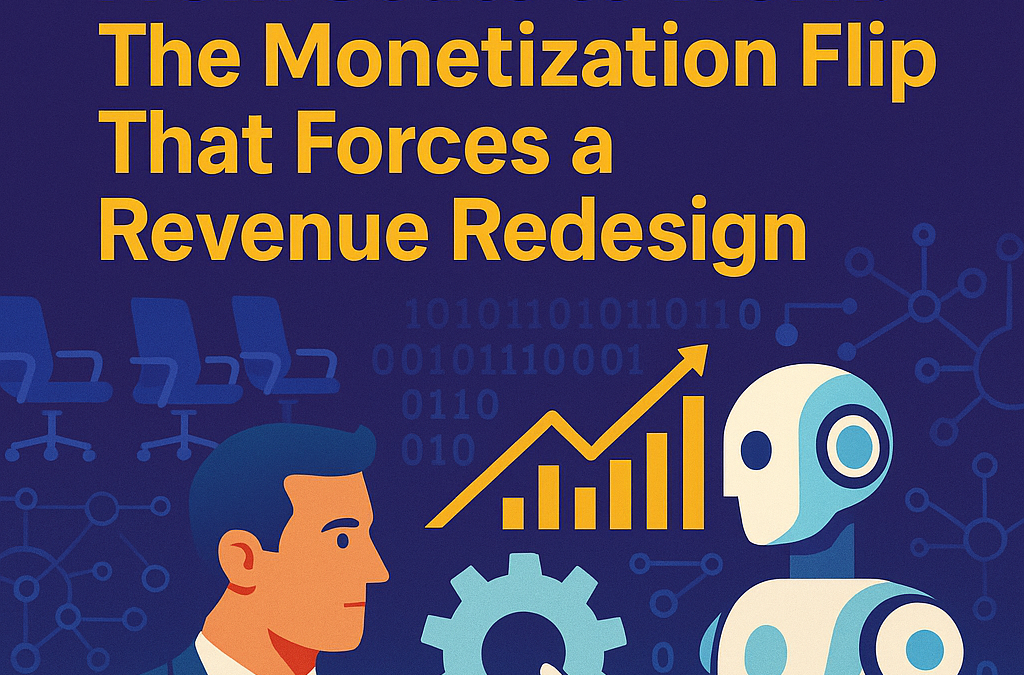
From Seats to Work: The Monetization Flip That Forces a Revenue Redesign
If you have just 1 minute
Revenue organizations are crossing a structural line: “productivity AI” is being replaced by operational AI—systems that execute work, not just recommend it. The immediate consequence is that the unit of value is no longer a human seat (SDR/AE/CSM time). It’s a completed task with auditable outcomes.
This matters now because the market has validated two hard truths in the same week: vendors can monetize autonomous execution at enterprise scale, and most enterprises are not operationally ready to govern it. The winners won’t be the teams with the most tools—they’ll be the leaders who redesign accountability, workflow ownership, and commercial models around machine-executed work.
If you own a forecast, a pipeline, or a renewal base, you should pay attention. Autonomy is becoming a revenue architecture decision, not an IT experiment.
This week’s developments you should not miss
Salesforce proves “work-based ARR” scales—and breaks seat economics
What happened
Agentforce hit $800M ARR with 169% YoY growth and 29,000 deals in a quarter—paired with Data Cloud at $2.1B ARR. More than a product story, this is a monetization story: charging for agentic work units rather than people.
Why it matters structurally
This is the clearest evidence yet that the “SaaS seat” is no longer the dominant commercial primitive in enterprise revenue tech. When vendors monetize execution, customers evaluate systems by throughput, reliability, and controls—not UI adoption. The procurement conversation shifts from “How many users?” to “How many outcomes per month, and what’s the failure mode?”
How this shifts revenue workflows
Sales motions will increasingly bundle “agent capacity” the way teams once bundled licenses. Expect packaging that ties price to pipeline actions (routing, follow-up, quoting), case deflection, renewal outreach, and data hygiene completion—forcing RevOps to track agent throughput as a first-class operational metric.
Who gains leverage
Revenue leaders who can define “work” precisely: standard operating definitions for qualified meetings, accepted opportunities, compliant quotes, and renewal touchpoints. Teams with mature data foundations (identity, hierarchy, product, entitlements) gain compounding advantage.
Who becomes exposed
Organizations still managing GTM as a collection of role-based activities. If your revenue system can’t express work as discrete, measurable units, you will overpay for autonomy and under-realize impact—because you can’t govern or optimize what you can’t instrument.
Microsoft pushes agents from “assist” to “execute” inside governance walls
What happened
Copilot Cowork moves beyond copilots into agents that read, coordinate, and act across calendars, documents, and workflows—with built-in identity, permissions, and auditability within Microsoft 365.
Why it matters structurally
This is a control-plane move. Microsoft is telling the enterprise: autonomy will be allowed to act only where policy enforcement, audit trails, and permissioning are native. That reframes “AI adoption” into “where do we have enforceable governance by default?”—which will shape which systems become execution hubs versus insight layers.
How this shifts revenue workflows
Expect automated pre-call preparation, deal review packets, competitive intel refresh, meeting hygiene, and stakeholder coordination to become “always on.” The less visible shift: management cadence changes. Weekly pipeline reviews become exception-driven, because agents continuously reconcile activity, next steps, and risk signals.
Who gains leverage
RevOps and Revenue Enablement teams who can codify standards and embed them into agent-run workflows (exit criteria, MEDDICC evidence, approval paths, data completion). Leaders who can shift managers from inspection to design—monitoring the system, not chasing updates.
Who becomes exposed
Middle layers of management that primarily coordinate, remind, and compile. That work will not disappear—but it will be priced, measured, and questioned when an agent can produce comparable outputs with better consistency and documentation.
Nvidia declares the infrastructure era of agents—and normalizes “context at scale”
What happened
At GTC, Nvidia positioned agentic AI as the next compute wave, introduced the Vera Rubin platform, and announced NemoClaw as an open platform for deploying agents. It also projected $1T cumulative revenue from Blackwell/Rubin chips (2025–2027).
Why it matters structurally
Revenue leaders should interpret this as a capacity signal: agentic execution is compute- and context-hungry, and the market expects sustained scarcity and premium pricing. Translation: autonomy won’t be “free productivity.” It will be a metered production resource—like cloud spend—requiring governance, budgeting, and optimization.
How this shifts revenue workflows
The cost of running “always-on agents” becomes a controllable line item. Finance and RevOps will start managing agent capacity the way they manage spiffs: allocate to the highest-yield motions (renewal rescue, pricing approvals, inbound qualification, multi-threading) and cut waste (low-quality outreach loops, redundant research, unbounded context runs).
Who gains leverage
Operators who can tie agent consumption to unit economics: CAC efficiency, pipeline coverage, renewal rate, discount discipline. Teams with instrumentation that connects compute/work units to revenue outcomes will win budget and credibility.
Who becomes exposed
Anyone treating agent rollouts as “licenses + training.” Without cost controls and outcome accounting, agent programs will look like cloud bills did in 2016: fast growth, unclear attribution, and inevitable backlash.
Enterprise readiness gap becomes the real risk: autonomy amplifies operational debt
What happened
A large share of leaders want to become “agentic enterprises” soon, while most admit their operations are not ready—citing data integrity, lack of context, stakeholder misalignment, and governance gaps (including agent identity and lifecycle control).
Why it matters structurally
Autonomy doesn’t tolerate ambiguity. A human rep can route around broken fields, undocumented exceptions, and tribal knowledge. An agent will either fail silently, execute the wrong thing at scale, or create compliance risk with perfect consistency. Operational debt becomes a competitive disadvantage, not an annoyance.
How this shifts revenue workflows
The bottleneck moves from “rep capacity” to “system clarity.” Deal stages, approval logic, entitlement rules, territory models, product packaging, and contract terms must be machine-interpretable. Organizations that cannot express their GTM as rules + exceptions will stall at partial automation.
Who gains leverage
Teams that treat process mining, data governance, and policy-as-code as revenue capabilities. Leaders who can align Sales, CS, Finance, Legal, and Security around one operating model for digital labor.
Who becomes exposed
Companies rolling out agents into fragmented stacks with unclear ownership. The first serious incident—mispriced quotes, unauthorized discounts, mishandled customer data—will freeze progress and damage internal trust.
Architecture Implications
What This Means for Revenue Design
Org charts will tilt from roles to systems. The classic segmentation (SDR → AE → CSM → RevOps) won’t vanish, but it will be overlaid by a new axis: who owns autonomous throughput. Expect “Agent Operations” to emerge as a real function—part RevOps, part risk, part enablement—owning agent policies, monitoring, and continuous improvement.
SDR/AE boundaries will be redefined by exception handling. Agents will take the first pass at research, routing, follow-up, meeting prep, and data capture. Humans will increasingly handle edge cases: multi-stakeholder negotiation, re-segmentation, complex procurement, and political risk. The best teams will redesign roles explicitly around “what the agent cannot safely decide.”
Forecasting will move from narrative to telemetry. When agents execute next steps and update fields as part of the workflow, forecasting becomes less about rep storytelling and more about system signals: verified stakeholder engagement, completed mutual action plan steps, pricing approvals, security reviews initiated, legal redlines resolved. Accountability shifts from “did you follow the process?” to “did the system achieve the required state transitions?”
Governance must evolve from access control to actor control. Enterprises need governed identities for agents, scoped permissions, lifecycle management, and audit trails. The hard problem: agents act across systems, not inside one app. Revenue leaders should expect to co-own this with Security and Legal because the blast radius includes discounting, contracting, entitlements, and customer communications.
Human judgment becomes more critical at the boundaries of trust. Where brand risk, regulatory exposure, pricing integrity, or strategic accounts are involved, the human role becomes “approver of intent” and “designer of guardrails,” not “operator of steps.” Leaders who cannot articulate trust boundaries will either over-restrict and lose value or over-delegate and create risk.
Early Warning Signs
Watch For This Inside Your Organization
- Your AI program reports adoption, not outcomes. If success metrics are logins, seats enabled, or prompts used, you’re funding activity—not autonomy.
- Workflows are undocumented but you’re building agents anyway. If exceptions live in Slack and approvals live in people’s heads, agents will harden chaos into production.
- RevOps is treated as a service desk for tooling requests. If every request is “add a bot” instead of “redesign the motion,” you’re accumulating more operational debt with better interfaces.
- Agents can act, but no one owns their failures. If there isn’t a named owner for agent identity, permissions, monitoring, and rollback, you’re one incident away from a freeze.
- Costs are invisible. If you can’t attribute agent consumption to pipeline, retention, or margin impact, autonomy will be cut the moment budgets tighten.
Strategic Move of the Week
If I Were a CRO This Week
I would create an “Agent Throughput Ledger” and force every autonomous workflow into it before scaling.
One-page operating constraint: no agent can be expanded beyond a pilot unless it has (1) a defined unit of work (e.g., “qualified meeting scheduled with verified ICP match”), (2) an explicit owner, (3) an audit trail and rollback plan, and (4) an outcome link to a revenue KPI (pipeline creation, cycle time reduction, renewal rate, discount leakage).
This is not bureaucracy. It’s the minimum viable control system for digital labor—so autonomy becomes a managed production asset, not a collection of experiments.
Closing Insight
Autonomy is not a feature upgrade; it’s a redesign of how revenue work is produced, measured, and governed. The companies that win in 2026 won’t be the ones with the most agents, but the ones that can convert agent execution into reliable operating rhythm: clear definitions, constrained permissions, auditable actions, and accountable outcomes. Seat-based thinking created org charts; work-based thinking will create systems. Revenue leadership now means designing the factory, not just hiring more operators.
All the best -Tim Cortinovis