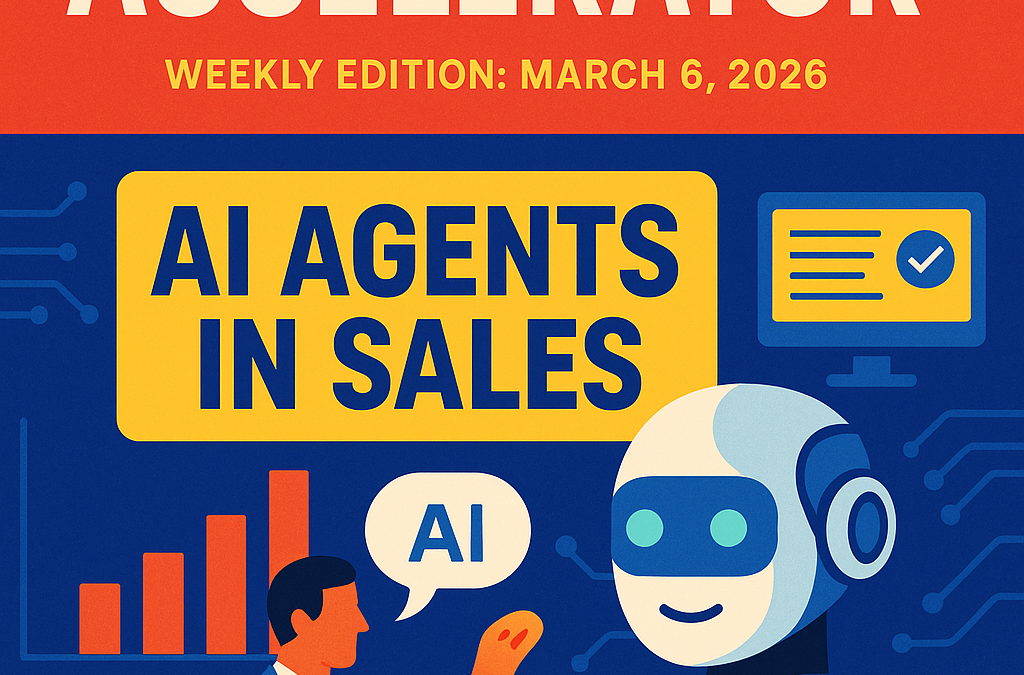
The Sales Accelerator
Weekly Edition: March 6, 2026
Editorial: Why This Week’s AI Developments Matter for Your Sales Strategy
Hello Innovators, Disruptors, and Future-Makers,
This week’s Sales Accelerator brings critical insights that are redefining how sales teams operate in 2026. The story is no longer about whether to adopt AI—it’s about how to operationalize it at scale to drive measurable revenue impact.
The data is unambiguous: organizations using AI are 1.3x more likely to see revenue growth, and sales teams deploying AI agents across their workflows are pulling ahead of competitors by significant margins. However, the gap between having AI and getting results from AI is widening dangerously. This week’s developments highlight four critical themes you need to understand:
- First, AI has crossed from experimentation to essential infrastructure. With 54% of sales organizations already deploying AI agents and 87% using some form of AI, the competitive advantage no longer comes from adoption itself—it comes from execution excellence. Salesforce’s latest data reveals that top-performing teams are 1.7x more likely to deploy agents than underperformers, suggesting that how you implement matters more than whether you implement.
- Second, data governance and integration are the real bottleneck. More than half of sales leaders cite disconnected systems as a drag on AI initiatives, and 74% are prioritizing data cleansing and integration. This isn’t a technical footnote—it’s a strategic imperative. Clean, unified data is the difference between AI that drives revenue and AI that generates noise.
- Third, your workforce will fundamentally change shape. Revenue leaders must prepare for 50/50 hybrid teams—half human, half AI—by year’s end. This requires new leadership skills, new performance metrics, and new hiring strategies. The organizations winning this transition are redefining roles, not just adding tools.
- Fourth, compliance and governance are moving from “nice-to-have” to mandatory. With AI agents making autonomous decisions at scale, enterprises need explainable systems, human-in-the-loop controls, and audit trails. The organizations that embed governance now will avoid costly retrofits later.
The teams winning in 2026 aren’t the ones with the most AI features—they’re the ones combining signal-based personalization, clean data foundations, explicit governance frameworks, and intentional workflow integration. This week’s news reflects that emerging reality.
Stay ahead with the latest AI innovations—here are the developments shaping sales in 2026.
This Week’s Critical Developments
- AI Agents Become Top Growth Tactic for Sales OrganizationsSalesforce’s 2026 State of Sales report surveying 4,000+ global sales professionals confirms AI agents have crossed the tipping point. The data shows 87% of organizations using AI and 54% already deploying agents across the sales cycle. Most striking: AI agents are slashing research time by 34% and content creation time by 36%. Top-performing teams are 1.7x more likely to deploy agents than underperformers—a competitive gap that’s growing rapidly. This signals a decisive shift toward operationalizing AI at scale, with organizations that move first establishing structural advantages.
- The 50/50 Sales Team Is Now Reality, Not TheoryForward-thinking CROs are already managing hybrid teams with 50% human reps and 50% AI agents. Companies are achieving 25-30% increases in revenue-generating activity time through intelligent automation, with goals of reaching 70-80% revenue-focused work per rep—compared to today’s 20-30% average. The shift demands entirely new management skills focused on system optimization, not just people leadership. Organizations that treat AI as a teammate rather than a tool are seeing 3-4x productivity increases per rep.
- Signal-Based Selling Replaces Volume-Based OutreachReal-time buyer signals are fundamentally changing how sales teams prospect. Signal-personalized outreach achieves 15-25% reply rates versus the 3-5% industry average for cold email. Research shows sellers using AI for prospect research save 1.5 hours per week—200+ hours per month for a 10-person team. The AI SDR market is projected to reach $15 billion by 2030, with 22% of teams already fully replacing human SDRs with AI. By end of 2026, expect the majority of initial outreach to be AI-generated and signal-triggered.
- Enterprise AI Governance Lags Behind AdoptionDeloitte’s 2026 enterprise AI report reveals a critical governance gap: only one in five companies has a mature model for governing autonomous AI agents, even as agentic AI usage is poised to surge. Worker access to AI rose 50% in 2025, and 40% of enterprise applications will feature task-specific AI agents by 2026. However, only 34% of enterprises report measurable financial impact from AI, with the leading reason cited being lack of enterprise-wide strategy. Organizations that embed governance now avoid compliance risks and unlock faster value realization.
- RevOps Becomes the Operating System of RevenueUnified revenue platforms are consolidating as enterprises recognize that AI’s value comes from intelligence flowing across a connected system, not from isolated features. RevOps teams are taking center stage, evolving from data custodians to strategic planners. Organizations with mature RevOps functions see 30% reduction in GTM costs and 40% increase in sales efficiency. The Salesloft-Clari merger signals consolidation trends—expect more as platforms integrate forecasting, conversation intelligence, CS health, and AI orchestration into unified revenue operating systems.
- Agentic Workflows Enable 24/7 Intelligent OperationsEnterprise CRM platforms are embedding AI agents directly into workflows rather than confining them to experimental tools. This shift enables 24/7 intelligence where high-volume tasks, data synthesis, and routine decisions are handled automatically while humans focus on strategic work. Real-time data intelligence and unified agentic workflows are transforming how teams engage customers, optimize operations, and achieve growth. The implication: organizations that operationalize AI within their core systems will outpace those using point solutions.
- Voice AI Agents Move Beyond Cold Calling Into Structured WorkflowsVoice AI agents are proving most effective in narrowly defined, high-volume workflows rather than complex negotiations. Success cases show value in speed-to-lead for opted-in inbound (response times under 60 seconds), rewarming warm lists without brand damage, and high-volume qualification lanes. The differentiator: reliable handoffs to human agents. Voice AI agents that cannot escalate cleanly become dead ends, hurting conversion rates. Best-in-class implementations treat voice AI as a triage and qualification layer, not a replacement for complex sales conversations.
- AI Agents for Compliance Become Strategic NecessityOrganizations are deploying specialized AI agents to monitor compliance, reduce manual audits, and stay audit-ready in real-time. AI compliance agents can reduce operational compliance costs by over 40% while increasing regulatory coverage. The emerging architecture includes data extraction agents, policy inference agents, violation detection agents, and audit trail agents working together. This multi-agent approach to compliance is particularly critical as agentic AI systems make autonomous decisions—explainability and auditability are no longer optional.
- Consumer Behavior Shift: AI Shopping Assistants Drive New Buying PatternsAI assistant usage among US shoppers has more than doubled year-over-year, rising from 12% to 35%, with over half (51%) of shoppers willing to let AI handle the entire shopping process including final purchase. This consumer shift is reshaping how brands engage buyers. The vast majority of retailers (88%) are open to enabling AI to complete purchases on behalf of shoppers, with 56% prioritizing this technology. This trend signals that B2B buyers—who consume B2C experiences—expect AI-driven personalization and frictionless transactions in business purchases too.
- 96% of B2B Marketers Using AI, But Data Challenges PersistNearly universal adoption of AI in marketing masks a deeper challenge: 18% of B2B marketers cite incomplete data as their single biggest barrier to confident decision-making. While 96% of marketers report using AI and 47% rank it as the number one trend they’re excited about, the primary driver remains efficiency (45% of respondents). The real bottleneck isn’t AI adoption—it’s having the clean, accessible data that AI needs to deliver personalized, signal-based campaigns. Organizations investing in unified data infrastructure now will own competitive advantage as AI capabilities accelerate.
What This Means for Your 2026 Sales Strategy
The evidence is clear: the companies winning in 2026 will be those that treat AI as an operating system, not a feature. This requires simultaneous investment in three areas: clean, unified data foundations; explainable, workflow-integrated agents; and governance frameworks that satisfy both compliance requirements and internal stakeholders.
The days of AI pilots are ending. The question shifting from “Should we use AI?” to “How do we scale AI responsibly and measure its revenue impact?”
Stay ahead. Stay focused. Stay human where it matters.