“`html
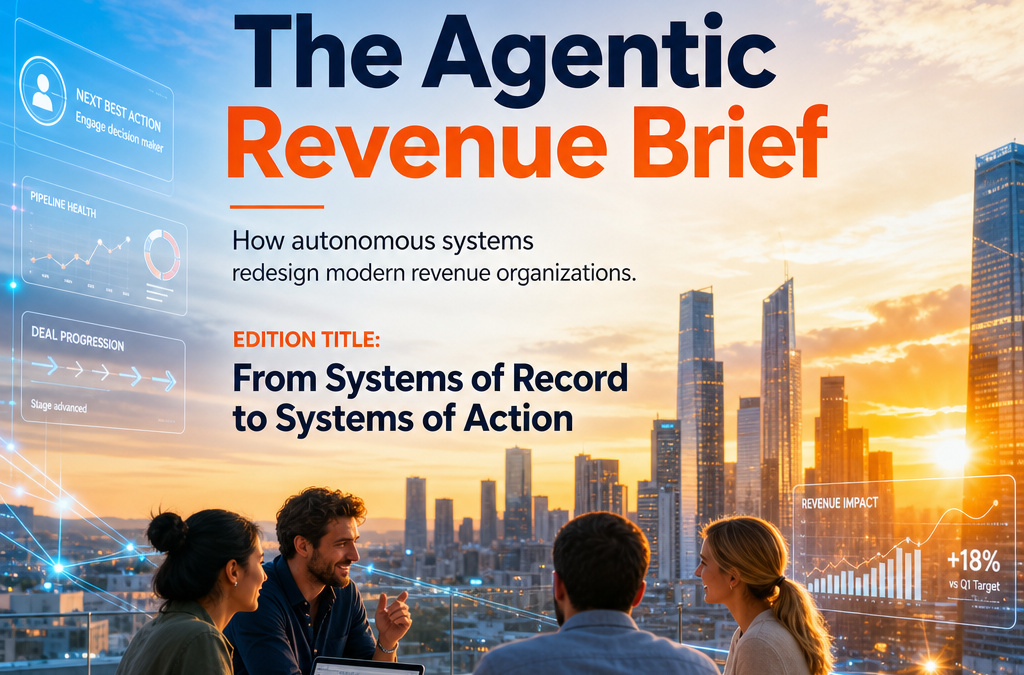
The Agentic Revenue Brief
From Systems of Record to Systems of Action
If you have just 1 minute
The structural change this week is not “more AI in sales.” It’s the quiet redefinition of what the revenue stack is:
platforms are being rebuilt as autonomous control loops that decide, execute, and learn across pipeline—not just report on it.
That matters now because revenue leaders are about to inherit a new accountability surface area: when agents act inside CRM, enablement,
and conversational channels, your “process” becomes software behavior. Forecast integrity, message consistency, and pipeline hygiene stop being
training problems and become governance problems.
Leaders who should pay attention: CROs and RevOps heads who own forecast credibility; CMOs who own demand quality; and founders who still think
“AI rollout” is a tooling decision rather than an operating model decision.
This week’s developments you should not miss
HubSpot Spring 2026: Agentic CRM becomes the default operating layer
What happened
HubSpot’s Spring 2026 release introduces agentic CRM primitives (Agentic Engagement Object, Smart Deal Progression, embedded agents) that are designed
to surface next actions and trigger execution within the deal context—moving beyond “assist” into “operate.”
Why it matters structurally
CRM is shifting from a compliance database into a behavioral engine. Once the CRM can autonomously advance stages, propose actions, and initiate workflows,
“pipeline management” becomes a product capability—not a managerial ritual. The org’s operating cadence will increasingly mirror how the system is configured,
not how the team is trained.
How this shifts revenue workflows
Deal progression stops being seller-updated and becomes system-negotiated: agents interpret evidence (emails, meetings, intent, engagement) and recommend or execute
movements. The implication: sales methodology enforcement migrates from playbooks to agent policies.
Who gains leverage
RevOps gains leverage—if they evolve from “CRM admins” into “agent operators” who can codify routing, qualification, and stage criteria as enforceable rules plus
learning loops. Sales leaders gain leverage by scaling consistent execution without scaling management layers.
Who becomes exposed
Teams with weak data discipline and ambiguous stage definitions get punished. If your CRM fields are performative, the agent becomes confidently wrong at scale—and
the forecast stops being a debate among humans and becomes a dispute with the system.

NVIDIA State of AI 2026: Revenue uplift becomes the enterprise KPI for agent deployments
What happened
NVIDIA reports broad AI budget resilience and widespread claims of measurable revenue impact, alongside accelerating movement from agent experimentation to deployment
across core functions.
Why it matters structurally
The market is normalizing “AI changes revenue” as an expectation, not a thesis. That changes internal capital allocation: agent programs will be judged like GTM investments
(payback period, pipeline impact, retention), not like IT modernization (uptime, license consolidation). In practice, that forces revenue leadership into the budgeting conversation
earlier—because agents are now part of the revenue production system.
How this shifts revenue workflows
If revenue impact is the north star, workflows reorganize around closed-loop execution: sensing (signals), deciding (policy), acting (tools), and learning (feedback). Forecasting becomes
less about “what reps say” and more about “what the system can verify.” The weekly forecast call will trend toward exception handling and risk adjudication, not status collection.
Who gains leverage
Companies that can instrument the funnel end-to-end (signal capture + routing + attribution) gain disproportionate leverage: they can prove ROI and scale budgets while competitors stay stuck
in pilot purgatory. Telecom/retail-style high-volume operators become the playbook exporters for B2B on orchestration and governance.
Who becomes exposed
Orgs that treat agents as productivity add-ons will fail the revenue bar. If you can’t tie agent behavior to conversion, cycle time, and retention, budgets will migrate to leaders who can.
Also exposed: teams that equate “deployment” with “permission.” Autonomy without auditability becomes an executive risk.
Highspot: Enablement pivots from content distribution to strategy enforcement inside live deals
What happened
Highspot’s agentic GTM framing positions agents as the layer that translates strategic initiatives (new verticals, messaging shifts, product focus) into guided actions at the deal level.
Why it matters structurally
Enablement is being redefined from “seller support” to “execution governance.” When agents operationalize strategy in-line, the organization reduces its dependence on training as the mechanism
of consistency. That’s a fundamental redesign: you are no longer hoping strategy propagates; you are embedding it into the workflow substrate.
How this shifts revenue workflows
Playbooks become dynamic policies. Content becomes an action primitive (what the agent sends, when, to whom), not a library. The feedback loop tightens: buyer engagement signals and win/loss
patterns can recalibrate agent guidance weekly, not quarterly.
Who gains leverage
Product marketing and enablement leaders gain leverage if they can define “strategic intent” in machine-executable terms (messaging constraints, qualification thresholds, approved claims).
Frontline managers gain leverage by focusing on deal exceptions and coaching judgment, while the system handles baseline consistency.
Who becomes exposed
Organizations with fuzzy ICP boundaries and inconsistent positioning get exposed quickly: agents cannot enforce what leadership cannot specify. Also exposed: teams that cannot validate outputs.
Without validation standards, “enablement” becomes a distribution channel for errors at scale.
Juniper: Conversational agents become a monetizable front door, not a support cost center
What happened
Juniper forecasts rapid growth in agentic conversational AI service revenue, driven by personalization expectations across customer experience.
Why it matters structurally
The “first touch” is shifting from humans and forms to autonomous dialogues that qualify, route, and upsell. That creates a new revenue surface area outside the classic SDR/AE sequence:
an always-on agent layer that can generate pipeline and expand accounts before a rep is even aware.
How this shifts revenue workflows
Inbound qualification becomes policy-driven and immediate. Handoffs become conditional: humans engage when the agent has created verified intent, captured requirements, and pre-assembled context.
The practical implication: pipeline attribution will shift toward “agent-influenced” touchpoints—forcing RevOps to redesign multi-touch models and acceptance criteria.
Who gains leverage
Teams that treat conversational channels as revenue channels (not ticket deflection) gain leverage: they can monetize speed and personalization. Marketing gains leverage by converting more demand
without expanding headcount, if governance prevents brand drift.
Who becomes exposed
Orgs with weak offer discipline and inconsistent pricing/packaging will leak margin through “helpful” agent behaviors. Legal/security teams become gating functions if conversational agents can
trigger account changes, discounts, or commitments without clear authorization boundaries.
What This Means for Revenue Design
Revenue org charts will start to resemble “control towers” more than linear funnels. Expect a new spine: Agent Operations—a capability that sits between RevOps, enablement,
and systems, owning agent policies, performance, and change management.
SDR/AE/RevOps boundaries will blur in one specific way: qualification, routing, and follow-up sequencing become system behaviors. SDR capacity becomes less about touches per day and more
about policy design (who qualifies, under what evidence, routed where, with which SLA). AEs will increasingly inherit pre-qualified, context-rich opportunities—while becoming the
“exception handlers” for edge cases and complex negotiations that agents should not touch.
Forecasting and accountability will shift from rep-updated stage hygiene to instrumented reality. When agents can move deals, trigger nudges, and log actions, the forecast becomes
a measurement problem: What evidence is acceptable for stage progression? Who can override? What constitutes “verified next step”?
Governance must adapt from static approval processes to runtime controls: guardrails, permissions, audit trails, and outcome validation. You will need a clear model for: agent authority levels,
escalation thresholds, and rollback. “Human-in-the-loop” stops being a slogan; it becomes a formal operating policy tied to risk and deal value.
Human judgment becomes more critical in three places: defining strategy in executable terms (ICP, messaging constraints), adjudicating exceptions (non-standard deals, brand risk), and redesigning
incentives (so humans don’t game the system and the system doesn’t optimize vanity metrics).
Watch For This Inside Your Organization
- Your “AI success metrics” are activity proxies (emails sent, meetings booked) rather than conversion, cycle time, expansion, and churn impact.
- You keep adding agent tools, but routing, stage criteria, and ICP definitions remain disputed across Sales/Marketing/CS. Autonomy can’t stabilize on ambiguity.
- Agents are deployed without explicit authority boundaries (what they can commit to, what they can change, what they can trigger). You have automation, not accountable autonomy.
- The forecast call is still dominated by “what changed in CRM” rather than “what evidence changed in the system.” That indicates the system is not trusted—or not instrumented.
- No one can answer who “owns” agent performance day-to-day (policy updates, QA, drift monitoring). If ownership is diffuse, errors will scale faster than learning.
If I Were a CRO This Week
I’d launch a 90-day Agentic Control Tower pilot with one narrow revenue loop: inbound-to-SQL in a single segment.
The structural constraint: no new SDR headcount and no “parallel process.” The agent must operate inside the existing CRM/enablement workflow, with explicit authority levels
(what it can send, route, and update) and an audit trail that ties actions to outcomes.
The capability build: appoint a single accountable owner (RevOps or Enablement) with permission to change routing rules, stage evidence thresholds, and messaging constraints weekly—treating it like
a revenue system, not a software rollout.
Closing Insight
Autonomy is forcing a shift from managing people executing processes to managing systems executing policies. The winning revenue orgs won’t be the ones with the most tools;
they’ll be the ones that can specify strategy precisely enough for agents to execute it—and govern outcomes tightly enough to trust the execution.
The competitive advantage is moving toward organizational design: who owns agent behavior, how quickly policies can be updated, and how cleanly evidence flows across the stack.
In that world, forecast accuracy becomes a byproduct of architecture.
All the best -Tim Cortinovis
“`