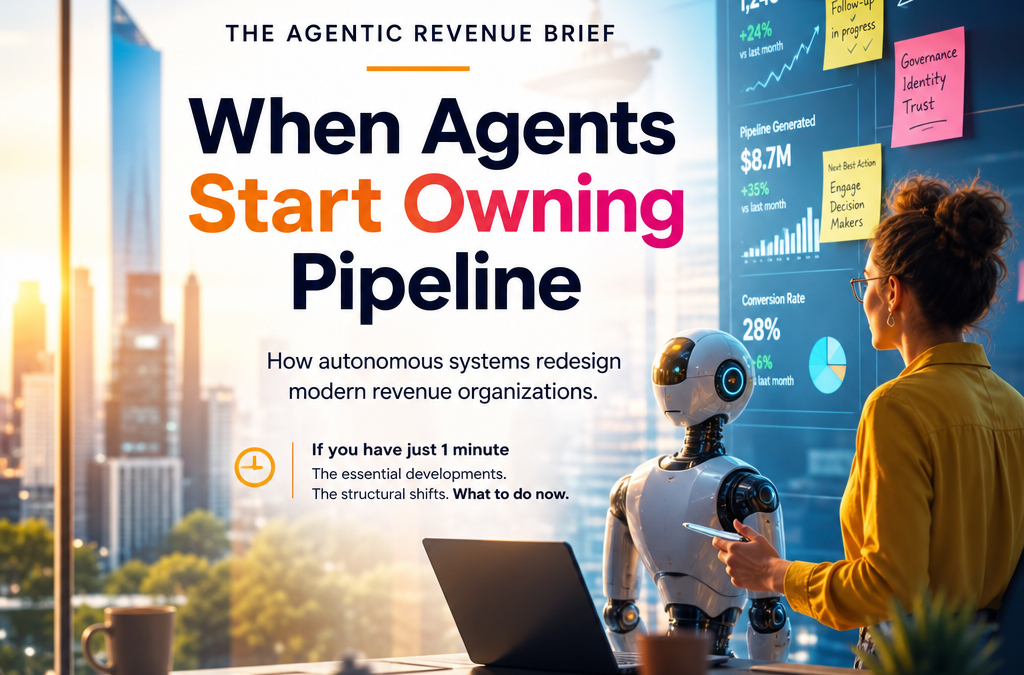
The Agentic Revenue Brief
How autonomous systems redesign modern revenue organizations.
Edition Title: When Agents Start Owning Pipeline
If you have just 1 minute
Revenue organizations are crossing a structural threshold: AI is no longer “helping reps do tasks” — autonomous systems are starting to own outcomes across multi-step motions (qualification → follow-up → routing → CRM truth → next-best action). That changes the unit of management from people executing steps to systems producing pipeline.
It matters now because the proof burden has shifted. Earnings narratives are tying autonomy to measurable capacity and bookings; capital is flowing toward autonomous sales operators; and security leaders are warning that agent-driven transactions break legacy identity and accountability models. The leaders who should pay attention are the ones responsible for capacity planning, forecasting integrity, and governance: CROs, RevOps, CIOs, and heads of risk/compliance. If you treat this as tool adoption, you will be structurally late.
This week’s developments you should not miss
Salesforce Q3 FY26 earnings: AI agents move from feature to capacity strategy
What happened
Salesforce’s quarter put AI agents and its data foundation (“Data 360”) in the same sentence as bookings momentum and a reported step-change in sales capacity.
Why it matters structurally
This is a platform CEO-level signal that the enterprise CRM is being repositioned from a system of record into a system of execution. When the core CRM vendor frames “capacity” as an output of agents + data, it implies that future revenue performance is constrained less by rep headcount and more by orchestration quality (data unification, permissions, decision logic, escalation design).
How this shifts revenue workflows
Sales motions migrate from rep-managed queues to agent-managed flows: agents determine next actions, maintain persistence on follow-up, and keep CRM truth current. “Activity” becomes an internal byproduct; the managed artifact becomes conversion throughput and time-to-pipeline.
Who gains leverage
RevOps leaders who control data models, routing logic, and policy. CROs who can re-allocate human time to high-discretion work (deal strategy, multi-threading, executive alignment) while agents run the volume layer.
Who becomes exposed
Orgs with fragmented customer data and unclear definitions (lead/account/contact ownership, stage criteria, handoff rules). Also exposed: sales leaders still managing via rep activity KPIs—because autonomy reduces visible “effort signals” while increasing system-driven outcomes.
Uber AI Solutions: the economics of agentic AI reframed as time-to-market and cost structure
What happened
Uber’s AI services arm framed agentic AI less as productivity tooling and more as an economic lever: faster time-to-market and lower operating cost.
Why it matters structurally
This reframes autonomy as a margin and velocity decision, not a “sales enablement” decision. Once the ROI conversation moves to time-to-market, agentic systems become part of corporate operating model design: how quickly you can launch segments, iterate messaging, stand up new motions, and adjust coverage without reorgs and rehiring cycles.
How this shifts revenue workflows
GTM experimentation becomes continuous. Instead of quarterly campaign planning and manual sequence rebuilds, agents can run controlled iterations: audience → message variants → follow-up policy → routing thresholds. Human teams move from “doing” to setting constraints and evaluating results.
Who gains leverage
Leaders who can define measurable economic targets for autonomy (CAC payback compression, cost-per-opportunity, sales cycle reduction) and instrument the system accordingly. Finance partners gain influence because the value case becomes legible in cost structure terms.
Who becomes exposed
Teams adopting agents without redesigning decision rights. If humans still approve everything, you get automation theater; if agents act without clear constraints, you get brand, pricing, and compliance risk. The exposed middle is organizations that can’t translate autonomy into a governed P&L narrative.
VCBacked funding roundup: capital shifts toward autonomous sales operators
What happened
Funding data highlighted AI as the dominant category, with sales-agent startups (e.g., SalesCloser AI) positioned around automated sales processes and personalized interactions.
Why it matters structurally
Capital allocation is a map of where the stack will re-form. Investors are not betting on “better sequences” or “smarter chat”—they’re betting on autonomous labor substitutes and workflow owners. That accelerates a competitive shift: differentiation moves from UI/feature sets to agent reliability, integration depth, and governance primitives (identity, audit, permissions, escalation).
How this shifts revenue workflows
Buyers will increasingly procure “pipeline-producing capacity” as software. The workflow boundary moves: the question won’t be “which outreach tool?” but “which entity owns top-of-funnel execution, and what’s the contract for handoff quality?” This pushes RevOps toward managing SLAs between human teams and machine teams.
Who gains leverage
Vendors and internal teams that can prove repeatable autonomy under real enterprise constraints (data heterogeneity, approval rules, regional compliance, brand policy). Operators who can run competitive bake-offs on outcomes, not demos.
Who becomes exposed
Point-solution stacks that can’t interoperate. Also exposed: sales orgs with no “agent control plane”—no standard for evaluation, monitoring, rollback, or drift detection. In that environment, every new agent increases entropy.
GovInfoSecurity / Human Security: agent identity becomes the new trust perimeter
What happened
Security leaders warned that as agents conduct digital transactions, enterprises need new models for identity, accountability, and trust.
Why it matters structurally
Autonomy breaks legacy accountability. If an agent can message customers, negotiate within bounds, update records, or trigger downstream actions, “who did what” becomes non-trivial. The enterprise needs an agent identity layer: unique identities, scoped authority, cryptographic or policy-based provenance, and auditable action trails. Without it, autonomy will be throttled by risk teams—or worse, deployed informally until a failure forces a halt.
How this shifts revenue workflows
Revenue workflows gain a new mandatory step: authorization design. Not just “what should happen,” but “who (human/agent) is allowed to do it,” under what conditions, and with what logging. Forecasting and pipeline hygiene become governance problems as much as process problems.
Who gains leverage
Security and compliance leaders who can enable safe autonomy quickly—by defining agent credentials, guardrails, and audit standards that scale across functions. RevOps gains leverage by partnering early and embedding governance into workflow design.
Who becomes exposed
Companies letting agents operate with shared credentials, weak audit trails, or unclear approval thresholds (discounting, legal language, data export, enrichment). Also exposed: any org equating “model safety” with “operational safety.” Most failures will be workflow and identity failures.
Salesforce event: verticalized agentic monetization (fan data → year-round revenue)
What happened
Salesforce packaged agentic AI as a vertical revenue engine—turning fan data into continuous monetization beyond event days.
Why it matters structurally
Verticalization is how autonomy becomes budgetable. When platforms can ship industry-specific agent playbooks, procurement shifts from “innovation spend” to “revenue program spend.” This is also a competitive warning: generalized GTM motions will underperform against companies that encode domain context into autonomous systems.
How this shifts revenue workflows
Data unification becomes directly monetizable. Agents can continuously detect segments, predict propensity, and trigger offers, collapsing the gap between insight and action. Marketing, sales, and service become less like separate departments and more like a single continuous revenue loop.
Who gains leverage
Organizations with clean first-party data and clear lifecycle definitions. Platform teams that can operationalize “always-on” engagement without inflating headcount.
Who becomes exposed
Teams still running episodic campaigns and manual segmentation. Also exposed: orgs with customer data locked in siloed systems—because vertical agentic strategies demand unified identity resolution and governance to work.
What This Means for Revenue Design
Org charts will tilt from roles to systems. The central design question becomes: “Which outcomes are owned by autonomous systems vs. humans?” Expect to see “Agent Ops” emerge as a RevOps sub-discipline: prompt-free workflow design, policy configuration, monitoring, and exception handling.
SDR/AE boundaries will compress. Agents will absorb a large portion of SDR volume work (research, first-touch, persistence, routing). Human SDRs either move up-market (strategic outbound, account penetration) or become human-in-the-loop closers for edge cases. AEs will spend less time on pipeline admin and more on multi-threading, deal design, and commercial strategy—if governance is done right.
RevOps becomes the governor of autonomy, not the admin of tools. The RevOps mandate shifts from tooling and process compliance to: decision rights, workflow constraints, escalation paths, and data truth. Forecasting will increasingly be a systems integrity exercise: validating that agent actions reflect real buying signals and that stage movement is policy-consistent.
Accountability will move from “rep did/didn’t” to “system behaved/failed.” You’ll need new primitives: agent-level quotas, SLAs for handoff quality, audit trails for key actions, and post-mortems for autonomous failures. Governance must define what agents can do unsupervised, what requires approval, and what is prohibited.
Human judgment becomes more critical in fewer places. The scarce human work will be: defining strategy, setting guardrails, handling ambiguity, managing executive relationships, and making trade-offs (pricing, legal, risk). The leadership challenge is ensuring humans are concentrated where judgment changes outcomes—not where tradition assigns labor.
Watch For This Inside Your Organization
Agent output is rising but pipeline quality is not. A sign you automated activity rather than built autonomous qualification and routing logic.
Every agent requires a new dashboard and a new owner. That’s tool sprawl disguised as autonomy. You’re adding surface area, not redesigning the system.
Security reviews happen after pilots are “working.” If governance is retrofitted, autonomy will be throttled later—usually after a customer-impacting incident.
Your CRM becomes less trusted as “automation” increases. When agents write to CRM without strict definitions and auditability, forecasting degradation follows quickly.
Humans are still the bottleneck for routine approvals. If discount bands, messaging policies, and routing thresholds aren’t encoded, you’ll never reach meaningful autonomy—just faster queues.
If I Were a CRO This Week
I would run a 30-day structural experiment: create an Autonomous Pipeline Pod with a mandate to own one measurable outcome end-to-end (e.g., “SQL creation for Segment X”). Give the pod authority to redesign the workflow across marketing → SDR → AE handoff, and require three things only: (1) a unified data contract (what fields are truth), (2) explicit agent permissions and audit logging, and (3) an outcome SLA (conversion + time-to-pipeline).
The constraint: no new tools unless they replace an existing step. The goal is to learn whether your organization can govern autonomy as a system—not whether a vendor can demo capability.
Closing Insight
Agentic revenue is not a tooling wave; it’s a redesign of how organizations produce growth. The winners will treat autonomy as an operating model with clear decision rights, identity, and accountability—not as a layer of assistants on top of broken workflows. The near-term competitive advantage will come from governance and data architecture as much as model capability. Leaders who can turn “who does the work” into “how the system behaves” will outpace those still managing revenue through human activity proxies.
All the best -Tim Cortinovis