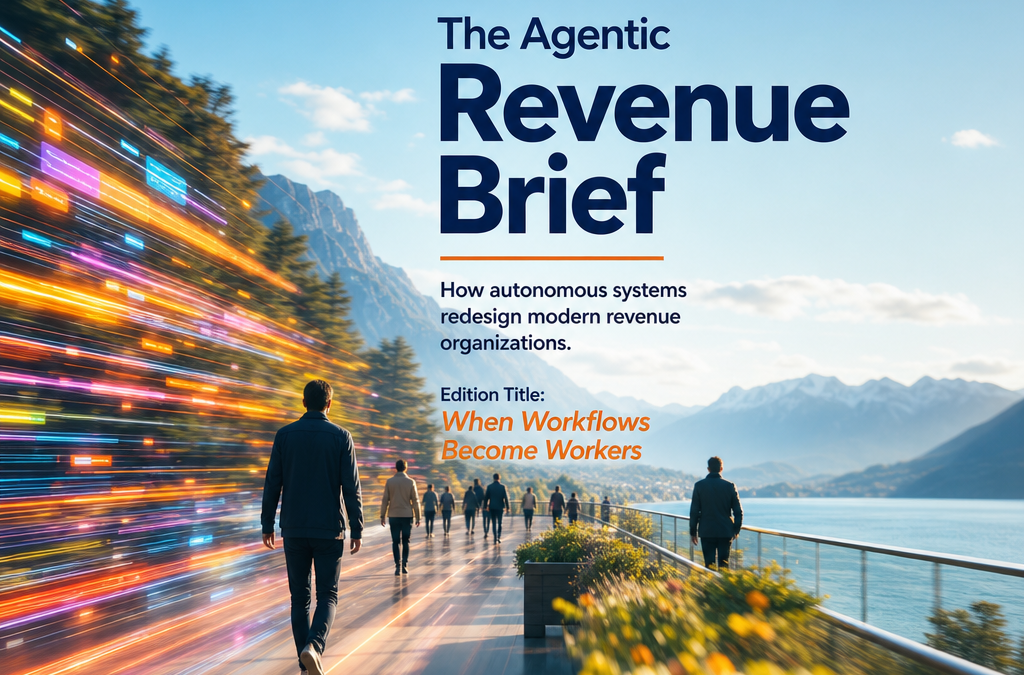
When Workflows Become Workers
If you have just 1 minute
The structural shift this week isn’t “more AI in sales.” It’s the promotion of autonomy to a first-class element of revenue design:
agents are being modeled as durable operators that can own sequences of work across systems, not assist humans inside a single tool.
That matters now because the limiting factor in enterprise growth is no longer “seller productivity” in isolation—it’s the throughput of the
revenue system: how fast opportunities are created, advanced, validated, and renewed with governance-grade consistency.
Agentic architectures change that throughput by relocating execution from roles to workflows.
Leaders who should pay attention: CROs and RevOps heads who are accountable for forecast integrity, pipeline hygiene, and capacity planning.
The winners won’t be the teams that “adopt agents.” They’ll be the teams that redesign accountability so autonomous work can be trusted at scale.
This week’s developments you should not miss
Microsoft: Agentic CRM “in the flow of work”
What happened
Microsoft positioned Dynamics 365 as an “agentic CRM” where agents operate across the selling surface area—email, calendar, CRM—executing steps
that historically required human initiation and manual updates.
Why it matters structurally
This is not a UI enhancement. It’s a redefinition of CRM from a system of record into a system of execution.
When the system can act, the operating model shifts: compliance and data quality stop being a seller discipline problem and become a platform control problem.
How this shifts revenue workflows
Expect fewer “update CRM” motions and more “approve / intervene” checkpoints. Work moves from human-driven task lists to agent-driven workflow runs:
follow-ups, stage progression prompts, meeting scheduling, and record maintenance become automated by default—with exceptions routed to humans.
Who gains leverage
RevOps gains leverage if it can encode process as enforceable guardrails (stage criteria, required artifacts, handoff rules).
Sales leaders gain leverage through consistent pipeline instrumentation—less storytelling, more auditable activity-to-outcome linkage.
Who becomes exposed
Orgs with “tribal CRM” (field-by-field norms, manager-dependent hygiene) get exposed: the agent will either amplify inconsistency or force an overdue standardization.
Sellers who relied on process ambiguity to manage scrutiny will face tighter operational accountability.
Ad banner
Download / View
Futurum on Salesforce State of Sales: Agents become the top growth tactic
What happened
Field data now frames agents as the leading growth lever, with adoption no longer confined to pilots and top performers disproportionately operationalizing them.
Why it matters structurally
Sales capacity planning is being rewritten. Headcount is no longer the only scalable unit of execution; “agent throughput” becomes a parallel capacity pool.
This forces a redesign of how you define coverage, activity standards, and quota attainment drivers.
How this shifts revenue workflows
The front half of the funnel (research, sequencing, personalization, first-touch consistency) becomes a machine-managed layer.
Humans increasingly enter at moments of ambiguity: multi-threading, political navigation, commercial tradeoffs, and mutual action plan enforcement.
Who gains leverage
Teams with clean data models and enforceable stage definitions: agents need deterministic gates.
Leaders with strong operating cadence: agent output can be inspected, benchmarked, and tuned like a production system.
Who becomes exposed
Any org whose “growth strategy” is still territory reshuffles and more SDRs will see diminishing returns as competitors scale execution without scaling payroll.
Also exposed: comp and attribution models that can’t explain where pipeline truly came from once agents generate meaningful share-of-voice.
HubSpot: Agentic Engagement Object + Smart Deal Progression
What happened
HubSpot introduced an “Agentic Engagement Object” (a contextual engagement layer) and embedded agents that can progress deals based on live engagement signals.
Why it matters structurally
This is a move away from record-centric CRM toward context-centric revenue systems.
In context-centric design, “truth” is not the deal record—it’s the evolving engagement state that determines what should happen next.
That’s the substrate autonomous workflows require.
How this shifts revenue workflows
Pipeline movement becomes more event-driven: engagement triggers progression, escalation, and content routing.
The system starts behaving like a revenue conductor, not a logging mechanism—reducing reliance on rep judgment for when to act, while increasing reliance on governance for how to act.
Who gains leverage
Marketing and Sales alignment gains a shared operational object (engagement state) instead of debated handoff narratives.
RevOps gains a more precise lever for enforcing SLAs: response timing, nurture logic, and deal-stall interventions become codified.
Who becomes exposed
Organizations that cannot define “good engagement” operationally (signals, thresholds, exclusions) will struggle.
If engagement definitions are fuzzy, agents will automate noise—creating activity inflation and false confidence in deal health.
BCG: The $200B opportunity shifts services from implementation to orchestration
What happened
BCG argued that agentic AI expands—not contracts—services demand, driven by the need to design, integrate, govern, and manage agent ecosystems.
Why it matters structurally
This is a warning to revenue leaders: if your operating model assumes “we’ll buy a feature and be done,” you’re behind.
Agentic revenue requires lifecycle management: versioning, testing, monitoring, auditability, and cross-system permissions—closer to running a production line than running a tool stack.
How this shifts revenue workflows
“Enablement” becomes continuous operations: maintain agent knowledge, update messaging, validate compliance behavior, and tune workflows as the market changes.
Sales process redesign becomes an engineering-adjacent discipline.
Who gains leverage
Enterprises that build an internal orchestration competency (RevOps + IT + Compliance) reduce dependency on external services and accelerate iteration.
Integrators and service firms gain leverage where clients lack governance and systems integration maturity.
Who becomes exposed
Tool-centric GTM leaders who can’t fund or staff orchestration will create fragmented agents that compete for control, duplicate outreach, and erode customer trust.
“Shadow agents” become the new shadow IT.
What This Means for Revenue Design
Revenue org charts will start to mirror how factories were redesigned for automation: fewer roles defined by tasks, more roles defined by control,
exception handling, and system quality. The key structural unit becomes the workflow, not the person.
SDR/AE boundaries shift first. SDR work (research, first-touch, follow-up persistence) is the most “agentizable,” which pushes humans up-market toward
deal engineering: multi-threading, exec alignment, and commercial architecture. AEs become orchestrators of complex cycles; SDRs either become
“agent supervisors” (quality + routing) or migrate into higher-skill discovery roles where ambiguity is highest.
RevOps expands from process owner to autonomy owner. Forecasting and accountability will split into two layers:
forecast as a financial commitment (human-owned) and forecast as a system signal (agent-generated, continuously updated).
The leadership question becomes: when the agent disagrees with the rep, whose view is operationally privileged—and what evidence is required to override?
Governance must adapt from “policy documents” to “runtime controls.” You will need permissions, audit trails, and standardized guardrails for:
what an agent can say, what it can change, and when it must escalate. The highest-leverage governance move is to define non-negotiable escalation gates:
pricing deviations, legal terms, regulated claims, competitive displacement language, and customer data access.
Human judgment becomes more critical in fewer places: defining strategy, setting thresholds, approving exceptions, and protecting trust.
The risk is not that agents replace judgment—it’s that they operationalize bad judgment at scale if leaders don’t encode clear intent.
Watch For This Inside Your Organization
- Your “AI wins” are isolated time-savers (email drafts, meeting notes) with no measurable impact on pipeline velocity, conversion, or forecast stability.
- Automation without escalation design: agents run tasks, but nobody can articulate the hard stops where human approval is mandatory.
- Multiple agents touching the same customer with inconsistent tone, timing, or offers—signals you are adding tools instead of redesigning a system.
- RevOps can’t explain agent attribution: pipeline increases, but source-of-growth is unclear, creating comp friction and internal distrust.
- “Agent output” is not auditable: no logs, no versioning, no clear linkage between agent actions and CRM changes—forecast confidence will decay, not improve.
If I Were a CRO This Week
I’d run a 30-day structural experiment: create an Agent Capacity Pod that owns one measurable workflow end-to-end—pipeline creation for a defined segment—
with a single scoreboard: meetings created, opps created, stage conversion, and complaint rate.
Constraints: one approved engagement definition, one escalation policy, one audit log standard. No new tools unless they plug into logging and governance.
If the pod can’t produce cleaner pipeline with fewer human touches, autonomy isn’t the issue—your process definitions are.
Closing Insight
Autonomy is not a feature wave; it’s an operating model change. The near-term competitive gap will come from governance and orchestration maturity,
not model quality—because the ability to let systems act safely is the true bottleneck.
Revenue leaders will be judged less on “AI adoption” and more on whether they can redesign accountability when work is performed by non-human operators.
The companies that win won’t have the most agents; they’ll have the clearest intent encoded into workflows, and the courage to standardize what humans were allowed to improvise.
All the best –
Tim Cortinovis