


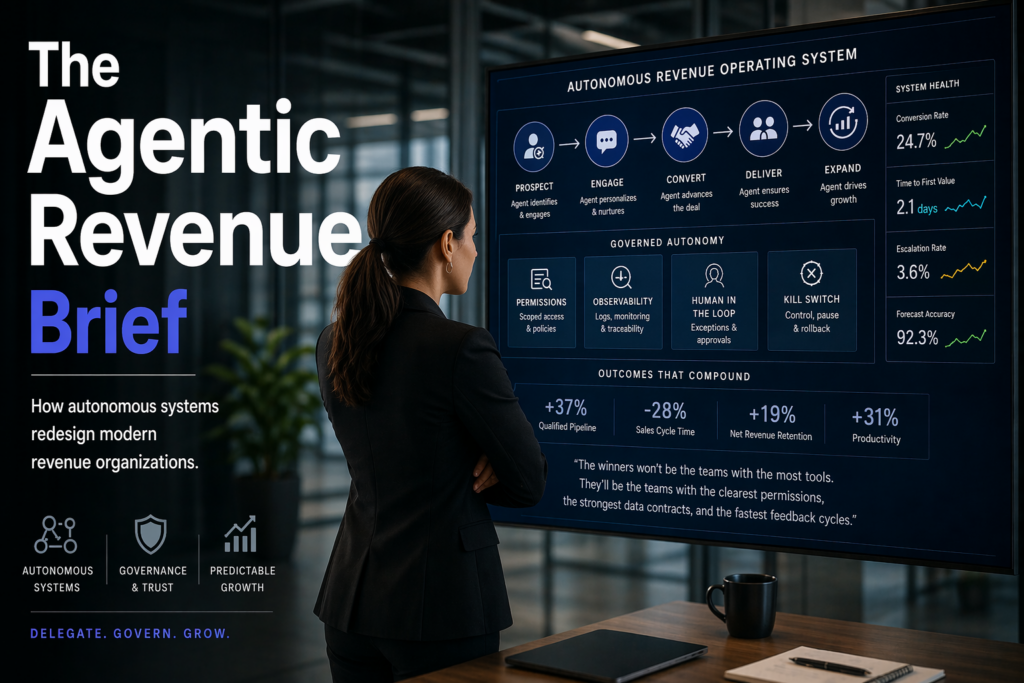
The Agentic Revenue Brief
How autonomous systems redesign modern revenue organizations.
If you have just 1 minute
Revenue organizations are moving from “instrumented workflows” to machine-executed operating systems. The structural change this week is not that more teams are deploying AI—it’s that leading platforms are starting to assign autonomous systems explicit ownership over revenue-adjacent outcomes: prospecting sequences, inbound resolution, compliance detection, and the security perimeter those agents operate within.
That matters now because the bottleneck is shifting. It’s no longer “Can we generate activity faster?” It’s “Can we govern autonomous actions without breaking accountability, trust, and forecast integrity?” Leaders who should pay attention are those who own pipeline quality, customer lifecycle economics, and risk—CROs, RevOps, and CMOs who are being pulled into what is effectively agent governance design.
If you are short on time, maybe you´d like to listen to our podcast for this edition.
This week’s developments you should not miss
HubSpot puts “Growth Context” to work with AEO and Smart Deal
What happened
HubSpot expanded its agentic layer across prospecting and deal execution logic—positioning “context” (CRM + behavioral + intent) as the substrate for agents that recommend, generate, and in some cases initiate revenue actions.
Why it matters structurally
This signals a platform shift from CRM as a system of record to CRM as a system of delegation. When context becomes the differentiator, the competitive moat moves from feature depth to permissioned data access + policy-defined actions. The “agent” is less a tool and more an organizational actor whose authority is bounded by governance rules.
How this shifts revenue workflows
Prospecting and early-stage pipeline creation move toward continuous machine-led orchestration: contact selection, messaging variation, follow-up timing, and routing logic become agent-run loops. Human contribution shifts upward to offer clarity, ICP definition, and exception handling—not sequencing mechanics.
Who gains leverage
RevOps leaders who own data definitions and routing policies. Marketing ops teams that control lifecycle stages and attribution rules. CROs who can standardize “what good looks like” into enforceable constraints.
Who becomes exposed
Sales orgs that still treat CRM hygiene as clerical. If context is wrong, the agent will industrialize error. Also exposed: teams whose differentiation is “rep hustle” rather than repeatable decision systems.
New book “Agentic Revenue Systems:How Revenue Leaders Build Autonomous Execution Engines for Predictable Growth”
A category-creating bridge between Revenue Architecture, RevOps, and Agentic AI leadership.”
Agentic Revenue Systems is a strategic playbook for revenue leaders entering the next era of growth.
For years, B2B revenue organizations have relied on human coordination to keep the machine running: top reps rescuing deals, managers patching forecasts, and teams working around fragmented systems. That model is reaching its limit.
In this book, I argue that the real shift is not from sales to AI tools. It is from manual coordination to governed autonomous execution.
This is not a book about hype, hacks, or bolting a chatbot onto your CRM.
It is a book about how modern revenue organizations are being redesigned around:
- autonomous execution
- human-in-the-loop control
- orchestration across sales, marketing, and RevOps
- governance, auditability, and trust
- faster signal detection and lower execution latency
- scalable revenue systems that do not depend on heroic individuals
Inside, you will learn how to move from:
- pipeline inspection to continuous orchestration
- tool sprawl to execution architecture
- rep-dependent performance to system-level advantage
- AI experimentation to governed revenue systems
You will also discover:
- the 4 levels of sales autonomy
- the Agentic Revenue Maturity Model
- how to design human-in-the-loop control architecture
- how to improve forecasting, pipeline defense, and expansion
- why most AI pilots stall, and how to move toward durable production
- what leadership must redesign to compete in an era of autonomous execution
If you are a CRO, VP Sales, RevOps leader, founder, GTM executive, or transformation-minded operator, this book gives you the language, models, and roadmap to redesign your revenue organization before competitors do.
Cloudflare launches Mesh to secure the AI agent lifecycle
What happened
Cloudflare introduced an infrastructure/security layer designed specifically around agent behaviors—securing identity, tools, data access, and execution pathways across an agent’s lifecycle.
Why it matters structurally
This is an admission that agentic systems are not just “software features”—they are new attack surfaces and new audit surfaces. As agents act across systems, security becomes inseparable from revenue execution. Expect “agent security” to become a gating factor for deploying autonomous pipeline generation, pricing actions, and renewal workflows.
How this shifts revenue workflows
The revenue stack can no longer be assembled as disconnected tools. If agents are the operators, then identity, authorization, logging, and rollback become core GTM requirements. RevOps will be forced into tighter coupling with security and IT on what actions an agent can take: who it can email, which records it can alter, which offers it can generate, and what triggers human review.
Who gains leverage
Security and platform engineering leaders who can define “safe autonomy” patterns. Revenue leaders who can articulate agent use cases as controlled systems with measurable risk bounds.
Who becomes exposed
Teams running agent pilots without an execution perimeter: no immutable logs, no scoped permissions, no kill switch. Also exposed: vendors and internal builders who can’t provide traceability from action → policy → data source.
Oracle brings new AI capabilities and agents to financial crime and compliance
What happened
Oracle extended agents into compliance and financial crime workflows—areas defined by high consequence, high regulation, and strict evidentiary requirements.
Why it matters structurally
When agents move into compliance, it marks a threshold: autonomy is being designed for domains where accountability must be provable. This pushes revenue orgs toward the same standard. If an agent can flag suspicious behavior with auditable reasoning, then a revenue agent will be expected to justify discounting recommendations, territory changes, or churn-risk interventions with comparable rigor.
How this shifts revenue workflows
Expect “agent + audit trail” to become standard for enterprise deals: every automated enrichment, outreach action, and routing decision will need lineage. The sales cycle increasingly includes controls conversations—not only security reviews, but governance reviews of autonomous systems that touch customer data and communications.
Who gains leverage
Operators who can build compliance-ready revenue motion: defined policies, documentation, clear approval gates, and evidence capture. Enterprise sellers who can translate governance into trust—and trust into cycle-time advantage.
Who becomes exposed
Organizations treating agents as a growth hack. In regulated industries (and increasingly all enterprise), undocumented autonomy becomes a procurement blocker and a reputational liability.
Perplexity’s ARR rises to $500 million
What happened
Perplexity’s ARR growth reflects accelerating monetization in an AI-native business where product value is tied to ongoing autonomous task completion rather than static software usage.
Why it matters structurally
The key signal is not the number—it’s the model: AI-native firms are proving that revenue scales with delegated outcomes (answers, actions, completions) more than seats. This is a preview of where B2B monetization will drift: from per-user pricing to per-workflow, per-resolution, or per-autonomous-run economics.
How this shifts revenue workflows
If customers buy outcomes, your GTM must sell operational change. The sales motion becomes less “feature demo” and more “delegation design”: what the agent will own, what it will escalate, what it will never do, and how it will be governed. Post-sale, CS becomes partly a policy tuning function.
Who gains leverage
Revenue leaders who can redesign packaging around measurable outcomes and implement instrumentation that ties autonomy to ROI. CMOs who can reposition from “product capabilities” to “operational throughput unlocked.”
Who becomes exposed
Seat-based businesses without a path to outcome-based value proof. Also exposed: sales teams that can’t sell governance and change management as part of the commercial bundle.
Yuma AI launches Ask Yuma for conversational support operations
What happened
Yuma pushed agentic automation deeper into customer support operations, targeting high-volume interactions and operational deflection with conversational agents.
Why it matters structurally
Support is becoming a revenue system, not a cost center—because agents can turn service into retention and expansion execution when connected to entitlements, health scoring, and commercial policy. The strategic shift is that the “front line” is increasingly an agent that can operate 24/7 under defined constraints.
How this shifts revenue workflows
Renewals and retention become more mechanized: agents resolve, triage, and route with consistent policy enforcement. Human teams focus on high-stakes saves, complex expansions, and relationship repair. The boundary between Support Ops and RevOps blurs because automation quality depends on shared data definitions (customer status, SLAs, product telemetry, contract terms).
Who gains leverage
Customer leaders who can treat support as a managed production system with clear escalation rules. RevOps teams that unify contract data, product usage signals, and service workflows.
Who becomes exposed
Organizations that automate tickets but don’t redesign escalation, ownership, and commercial authority. If the agent can resolve issues but can’t trigger the right human intervention at the right time, you’ll “deflect” volume while leaking revenue through churn.
What This Means for Revenue Design
Org charts will evolve from roles to control loops. You will still have SDRs, AEs, CSMs—but the differentiator will be who owns the autonomous loops: prospecting loop, routing loop, renewal-risk loop, compliance loop. Leaders will be measured on loop performance, not activity volume.
SDR/AE/RevOps boundaries will blur into “delegation design.” SDR work becomes policy + messaging libraries + exception handling. AEs become closer to deal strategists and commercial negotiators. RevOps becomes the author of constraints: permissions, definitions, routing logic, and auditability.
Forecasting shifts from manager judgment to system observability. As agents generate activity and move records, forecasts must incorporate agent reliability: false positive rates, escalation latency, and conversion quality. Pipeline becomes less a “report” and more a monitored system with drift detection.
Governance must adapt from approvals to permissions. The old model: human does work, manager approves. The new model: system is permitted to act within bounds, and humans intervene on exceptions. This requires scoped access, immutable logs, and explicit kill-switch ownership.
Human judgment becomes more critical at the boundaries. ICP shifts, brand risk, pricing ethics, regulated data handling, and strategic account decisions cannot be fully delegated. Humans move to where context is ambiguous and consequences are high—while agents handle the repeatable middle.
Watch For This Inside Your Organization
- Your “AI wins” are activity metrics, not outcome metrics. More emails, faster responses, higher automation—without measurable improvement in qualified pipeline, cycle time, retention, or margin.
- You can’t explain what the agent is allowed to do. If permissions, escalation rules, and audit trails aren’t documented, you’re not building autonomy—you’re shipping risk.
- RevOps is excluded from agent design. If agents are deployed by individual teams without shared data definitions and routing policy, you will create competing versions of truth.
- Humans are still doing “agent babysitting.” If reps spend time correcting outputs, reformatting messages, or cleaning CRM side effects, you’ve automated chores—not redesigned workflows.
- Security and compliance only show up at procurement time. If governance enters late, deals slow, autonomy gets restricted, and your early advantage collapses under enterprise scrutiny.
If I Were a CRO This Week
I would create an “Agent Authority Matrix” and run one controlled autonomy experiment.
Pick a single loop—e.g., inbound lead routing + first-touch outreach—and define: what the agent can do, what it can’t do, what requires human approval, and what must be logged. Instrument it like a production system: conversion quality, escalation rate, error rate, and time-to-first-value. Then assign an owner who is accountable for the loop end-to-end (not just the tool).
The constraint I’d impose: no agent action without traceability (data source + policy + outcome). If you can’t audit it, you can’t scale it.
Closing Insight
Autonomy is turning revenue into an engineered system—one where competitive advantage comes from how cleanly you can delegate, govern, and improve operational loops. The winners won’t be the teams with the most tools; they’ll be the teams with the clearest permissions, the strongest data contracts, and the fastest feedback cycles. As agents become the control plane, leadership shifts from motivating people to designing accountability across humans and machines. The orgs that treat this as architecture—not automation—will compound speed without compounding risk.
All the best -Tim Cortinovis