


From Tool Adoption to Revenue Autonomy
If you have just 1 minute
Listen to this edition´s podcast episode.
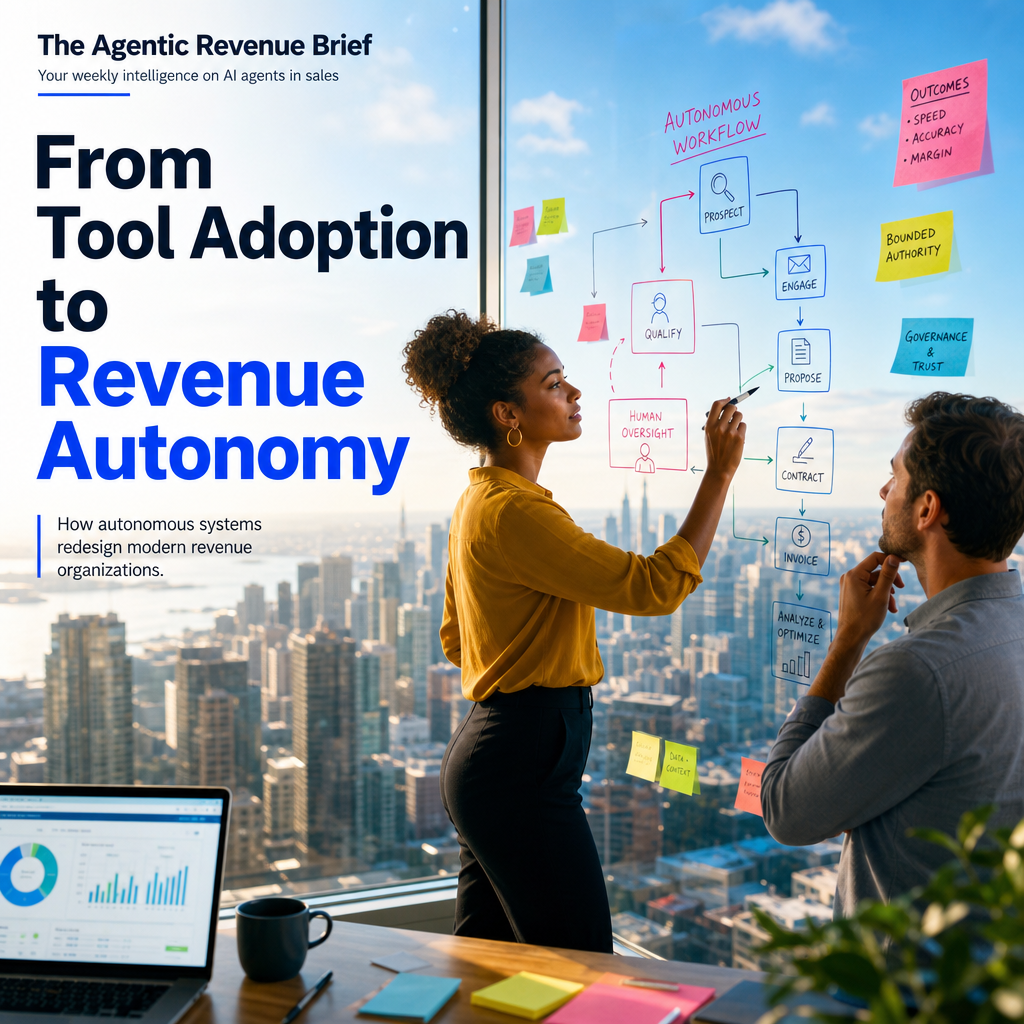
Revenue organizations are crossing a structural threshold: AI is no longer being evaluated as an assistive layer inside existing roles, but as an operating layer that can own multi-step work across systems—prospecting through contracting through invoicing—under bounded authority.
That matters now because pilot-to-production conversion is accelerating at the same time the true cost of running agents at scale is surfacing. In other words: autonomy is becoming operational, and the economics are becoming board-visible.
Leaders who should pay attention: CROs and RevOps heads who manage cross-functional throughput (pipeline → close → cash), and CMOs who increasingly “own” the top-of-funnel systems agents will soon orchestrate. If you treat this as tool selection, you’ll miss the redesign moment—and inherit a governance and margin problem later.
This week’s developments you should not miss
State of Agentic AI Q2 2026: funding surge + higher pilot-to-production
What happened
Capital and enterprise adoption signals converged: funding volume is massive, and the more important indicator is that organizations are moving agents into production materially faster.
Why it matters structurally
Production agents change the governance model. In pilots, failures are learning. In production, failures are customer-impacting decisions executed at machine speed. This shifts “AI oversight” from innovation teams to revenue leadership, because revenue workflows are where autonomy quickly turns into contractual, financial, and reputational exposure.
How this shifts revenue workflows
Expect a migration from “seller executes steps” to “seller approves and steers.” The workflow center of gravity moves into systems: agents monitor triggers (intent, usage, stage changes), execute sequences, and update records. Humans intervene at escalation thresholds, not at every action.
Who gains leverage
RevOps leaders who can standardize processes and data definitions gain disproportionate influence—because agent performance is a direct function of process clarity + system connectivity. Teams with clean account hierarchies and disciplined stage hygiene will appear “more AI-ready,” even if their people are identical.
Who becomes exposed
Sales orgs dependent on tribal knowledge, bespoke deal crafting, and informal approval paths become brittle. When an agent needs rules and audit trails, “how we usually do it” becomes an operational liability.
Agentic AI costs at scale: the bill arrives
What happened
Infrastructure voices are now explicitly warning that scaling agentic workloads introduces continuous compute, heavy orchestration traffic, and observability/storage overhead. The hidden tax isn’t the model call—it’s the long-running system behavior.
Why it matters structurally
This reframes agentic AI from “enablement spend” to a new line item that behaves like cloud infrastructure: it must be governed with unit economics. Revenue leaders will be pushed to answer: cost per qualified meeting, cost per proposal issued, cost per invoice reconciled. Autonomy without unit-cost discipline will be treated as margin erosion.
How this shifts revenue workflows
You will see lifecycle-managed agents: spun up for a defined window (deal stage, renewal window, collection cycle), then terminated. That means revenue workflows must be redesigned into event-driven sequences with explicit start/stop conditions—an architectural shift from today’s always-on dashboards and human task lists.
Who gains leverage
Operators who can define “cost per outcome” benchmarks gain control of the roadmap. The winners will be teams that can say: “This agent produces X incremental pipeline at Y infrastructure cost,” and then optimize it like any other growth channel.
Who becomes exposed
Any org scaling agents without instrumentation will get surprised—first by cloud bills, then by internal credibility loss. The common failure mode will be expanding autonomy before proving economic efficiency + behavioral reliability.
Microsoft Copilot Cowork: multi-tool, long-running agents embedded in the productivity layer
What happened
A major productivity suite is formalizing a shift from copilots to agents that can run long-horizon, multi-application workflows using organizational context across email, docs, spreadsheets, and collaboration spaces.
Why it matters structurally
This is a distribution and interface reset. When the agent lives where revenue work already happens, “AI adoption” stops being a separate initiative and becomes a default operating capability. That forces revenue teams to govern not a vendor tool, but an ambient layer of autonomy inside daily work.
How this shifts revenue workflows
Account planning, mutual action plans, multi-threaded stakeholder coordination, and internal approvals become agent-orchestrated by default. The practical consequence: a lot of what looked like “sales execution” becomes sales supervision—reviewing drafts, approving next steps, adjudicating exceptions.
Who gains leverage
Organizations with disciplined permissioning, information architecture, and clean content repositories gain an immediate advantage. Agent quality will mirror content quality; the firms with curated sales collateral, pricing logic, and documented playbooks will outperform even with similar talent.
Who becomes exposed
Companies with messy shared drives, unclear access controls, and outdated decks create agent risk: wrong documents, wrong context, accidental disclosure. The exposure isn’t theoretical—it shows up as customer-facing errors delivered confidently at scale.
Funding concentration: category leaders are buying the right to define “agent primitives”
What happened
Funding is concentrating in a small set of players building foundational agent capabilities (autonomous coding, prompt-to-app). This is less about sales tools and more about the manufacturing layer for agents.
Why it matters structurally
The ability to build and modify agentic workflows becomes a competitive capability, not an IT backlog. If agent construction becomes cheaper and faster, the differentiator shifts from “which CRM” to “how quickly you can encode and iterate go-to-market logic.” This is the start of GTM as software, executed by autonomous systems.
How this shifts revenue workflows
Expect internal “agent factories” inside RevOps: rapid build-test-deploy loops for workflow changes (routing, sequencing, pricing approvals, renewal plays). The weekly cadence of GTM iteration compresses; what used to be quarterly process change becomes continuous optimization.
Who gains leverage
RevOps teams that can partner with engineering—or that can build lightweight internal apps—gain speed and bargaining power. They stop being the ticket queue and become the revenue systems product team.
Who becomes exposed
Revenue orgs locked into rigid vendor workflows will struggle to keep pace. If competitors can rapidly refactor their GTM system behavior, static processes become a strategic disadvantage, not just an efficiency problem.
What This Means for Revenue Design
Org charts will tilt toward “system owners,” not just team leaders. You will see new accountability centers: Head of Revenue Automation, Agent Governance Lead, or “GTM Systems Product” under RevOps. The job is not enablement—it’s designing autonomous throughput.
SDR/AE boundaries will be renegotiated. If agents can prospect, research, draft, and follow up, the SDR function shifts from activity generation to exception handling and signal quality. AEs become less about pushing steps forward and more about orchestrating stakeholders and tradeoffs (pricing, security, legal, exec alignment).
RevOps becomes the control plane. The value moves from dashboarding to policy: escalation thresholds, allowed actions, audit design, and workflow lifecycle management. RevOps will own the “rules of autonomy” the way finance owns spending policy.
Forecasting and accountability will change shape. When agents execute large portions of pipeline creation and progression, classic activity metrics degrade. The accountability debate shifts to: which outcomes are attributable to agent systems vs. human judgment, and who “owns” the failure when an autonomous workflow produces pipeline that doesn’t convert. Expect more focus on conversion integrity and cost per outcome.
Governance must mature beyond compliance checklists. Bounded autonomy becomes operational design: what agents can do, where they can write data, which actions require approval, and how decisions are reconstructed. Auditability becomes a revenue requirement, not a legal one—because revenue outcomes will increasingly be produced by non-human operators.
Human judgment becomes more critical in fewer places. Not everywhere—just in the expensive places: deal strategy, risk tradeoffs, executive messaging, and exceptions. The leaders who win will protect human attention for the decisions that actually move enterprise deals, while letting autonomous systems own the rest.
Watch For This Inside Your Organization
Agents are “busy,” but unit economics are unknown. If you can’t state cost per qualified meeting or cost per contract cycle reduction, you’re scaling motion, not scaling advantage.
You’re automating steps, not redesigning the workflow. If the agent drafts emails but humans still copy/paste between systems, you built a faster typewriter—not an autonomous process.
RevOps is excluded from agent design. If innovation teams deploy agents without RevOps policy, data standards, and logging requirements, production will stall or create shadow operations.
Your data model cannot support persistent context. Duplicate accounts, unclear hierarchies, inconsistent stages, and undocumented discount logic will surface as “agent errors,” but they are governance debt.
Escalations are ad hoc. If humans override agent actions without capturing why, you can’t improve the system. You’re creating an autonomy layer with no learning loop—and no defensible accountability.
If I Were a CRO This Week
I’d launch a Quote-to-Cash Autonomy Pilot with hard boundaries—not a sales email pilot.
Scope: one segment, one region, one set of products. Mandate that the agent can draft quotes, validate configurations, route approvals, and prepare invoices—but cannot approve discounts beyond a threshold or send contractual redlines without sign-off. Instrument it end-to-end with three metrics: cycle time impact, exception rate, and cost per processed deal.
Why this move: it forces cross-functional design (Sales + Finance + Legal + RevOps), exposes data/process debt immediately, and ties autonomy to outcomes the board actually cares about: speed, cash, and controllable risk.
Closing Insight
Agentic AI is becoming less like a new tool category and more like a new operating substrate for revenue work. The competitive gap won’t come from who “uses agents,” but from who can encode their revenue strategy into bounded, observable, economically efficient autonomous systems. The hard part is not capability—it’s accountability: defining who owns decisions when decisions are executed by software with initiative. The next generation revenue leader will be judged less on coaching and more on systems design.
All the best -Tim Cortinovis